 EVERYTHING


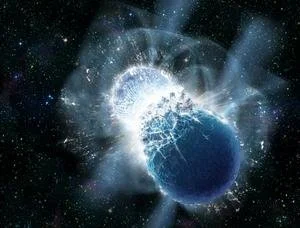
An international research team based at GSI/FAIR has introduced a novel simulation model, RHINE, which leverages machine learning to gain deeper insights into element formation during stellar catastrophes such as neutron star mergers. The scientists utilized deep learning with a neural network to accurately model the energy release associated with r-process nucleosynthesis within hydrodynamic simulations. According to Eurekalert, these findings are published in the journal Physical Review D and represent a significant advancement in computational astrophysics.
The Challenge of Heavy Element Production
Many essential chemical elements known throughout the universe originate from massive stellar events. These explosions or mergers release immense amounts of energy necessary for producing heavy nuclides. A critical nuclear production mechanism is the rapid neutron-capture, or r-process. This process involves existing nuclei capturing free neutrons and converting them into protons, thereby creating larger, heavier atomic nuclei.
Modeling these complex reactions theoretically requires extraordinary computing power, which often necessitates simplifying the models to make them manageable. Dr. Oliver Just, first author of the publication and a researcher in GSI/FAIR’s Nuclear Astrophysics & Structure department, noted that researchers globally strive to understand these processes through simulations but face severe computational limitations.
Accelerating Simulations with Machine Learning
The RHINE model offers an efficient alternative by integrating artificial intelligence into the simulation framework. Specifically, it uses machine learning (ML)—a neural network based on deep learning—to describe the energy release from nuclear reactions during the r-process in hydrodynamic simulations of these events.
Dr. Zewei Xiong explained the methodology: “First the ML models are trained using a large number of reference calculations produced with a full set of nuclear reactions. Subsequently, the models are adopted in running hydrodynamical simulations to approximate the heating rates during the r-process with minimal effort.”
- The RHINE model approximates heating rates efficiently within complex hydrodynamic environments.
- It is validated against extensive reference data derived from complete sets of nuclear reactions.
- Its implementation allows for a significant reduction in overall computational time required for simulations.
Impact on Astrophysical Observations
This simulated "heating" has profound implications for the dynamics and velocity distribution of material ejected by these stellar explosions. Consequently, it also affects the electromagnetic radiation that can be observed from neutron star mergers as a kilonova. The high degree of agreement between the ML scheme and reference data suggests that accounting for r-process heating is an important effect that must be better integrated into future modeling efforts.
The ability to conduct more detailed simulations, thanks to RHINE, could directly link experimental results from the future FAIR facility with real observations of stellar explosions. The source code for the RHINE model has been made publicly available for wider scientific use, and the project received co-funding from the European Research Council (ERC).
The successful application of deep learning in this domain marks a crucial step toward bridging theoretical nuclear physics with observational astrophysics.