 EVERYTHING


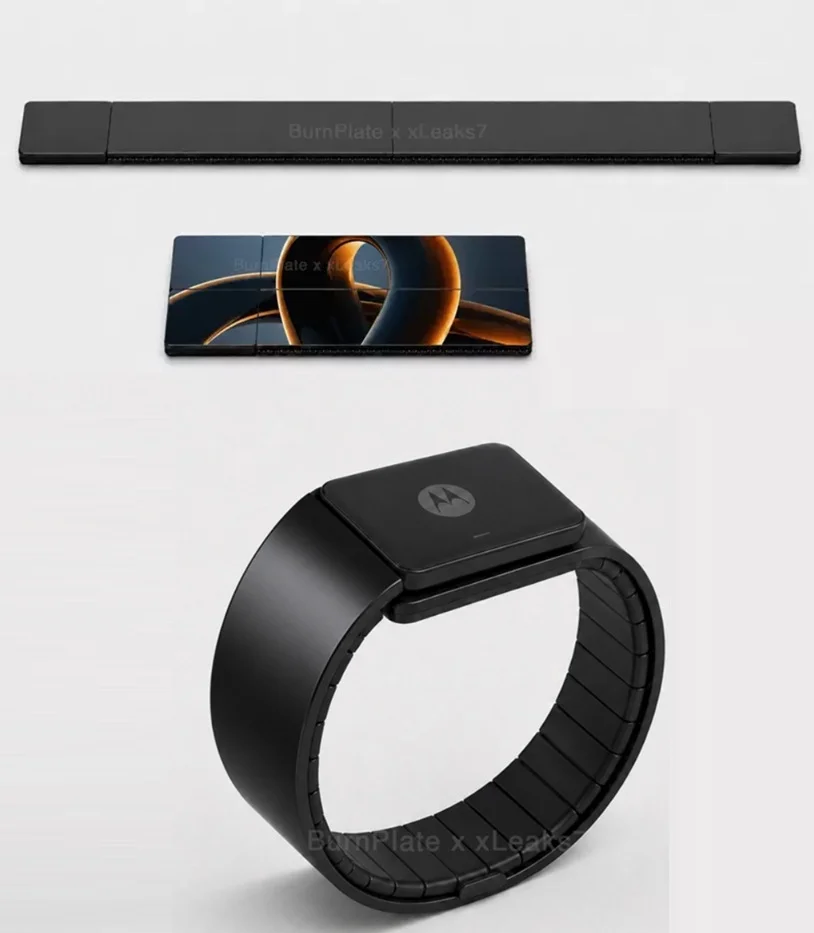
Flexible Display Band Wraps the Wrist
Patent documentation published on 10 August 2026 details a Motorola design for a mobile device built around a fully flexible AMOLED panel. Unlike traditional smartwatches that rely on rigid cases attached to leather or silicone straps, this concept uses a continuous display band that wraps directly around the user's wrist. Magnetic fasteners positioned at both ends lock the screen into a comfortable bracelet shape.
The design eliminates the physical divide between phone screens and wearable displays. When worn on the arm, the outer surface remains active to present time, notifications, and health metrics. Internal sensors adjust the interface automatically based on how far the band curves, ensuring readable orientation regardless of wrist movement.
Unfolding Mechanism and Hands-Free Utility
Removing the device from the wrist unlocks a broader range of uses. Unbending the hinged segments flattens the band into a standard rectangular phone screen, allowing users to text, browse, and navigate apps just like on a conventional smartphone. Magnetic locks across the structural joints maintain rigidity when the panel is fully extended.
The flexible hinge architecture also enables alternative viewing setups. Bending the display into an L-shaped bend converts the device into its own desktop kickstand for video calls or watching content without requiring an external case. Key hardware components—including the primary processor, wireless antennas, and split battery modules—are housed inside the thicker terminal ends of the band to keep the central display area slim.
Durability Limits and Component Placement Challenges
While Motorola has a history of experimenting with flexible form factors—tracing back to its iconic 2004 Razr line—bringing a wrist-unfolding hybrid to retail stores involves complex engineering trade-offs. Frequent flexing puts continuous mechanical stress on display layers, raising concerns about long-term crease durability and screen integrity.
Ergonomics and component placement present additional challenges. Hardware placed on the underside of the band comes into direct contact with skin and sweat, while integrating cameras on a flexible surface without disrupting screen continuity remains an unsolved puzzle. If Motorola overcomes these hurdles, the boundary between wearables and primary smartphones could dissolve permanently.