 EVERYTHING


According to Nature, a new study has introduced an intelligent framework designed to mitigate the ecological impact of offshore wind farms on avian populations. As global demand for low-carbon energy drives the expansion of these facilities, concerns regarding bird collisions with rotating blades have intensified. The proposed system addresses the limitations of traditional methods, such as manual monitoring and acoustic deterrents, which often suffer from high false alarm rates and a lack of species-specific identification.
Deep learning for precise avian classification
The core of the new framework is a Bird Detection and Classification (BDC) model powered by a Deep Convolutional Neural Network. To ensure high reliability, researchers trained the model on an extensive dataset featuring over 90,000 images across 525 different avian species. The study compared this DCNN-based approach against several conventional machine learning classifiers, including Support Vector Machines (SVM), Random Forest, K-Nearest Neighbor, and VGG16.
The results indicated that the proposed BDC model significantly outperformed its counterparts in accuracy and reliability. Key performance metrics for the new system include:
Automated SCADA integration and response
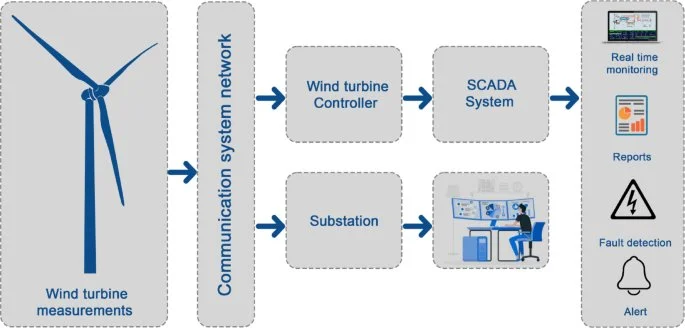
Beyond simple identification, the framework is designed to translate visual data into immediate operational actions. The system utilizes a multi-zone proximity assessment strategy that communicates directly with a Supervisory Control and Data Acquisition (SCADA) system. This allows for automated turbine control, such as slowing or stopping blades when high-risk birds are detected in close proximity.
Simulation tests demonstrated that the framework is capable of rapid execution, achieving an inference latency of less than 30 ms and a SCADA response time within 40 ms. While researchers acknowledge that these results were achieved under controlled conditions—and may face challenges like motion blur or complex offshore backgrounds in real-world settings—the study provides a robust proof-of-concept. It establishes a pathway for integrating AI-driven monitoring with industrial control to create more environmentally sustainable wind energy operations.