 EVERYTHING


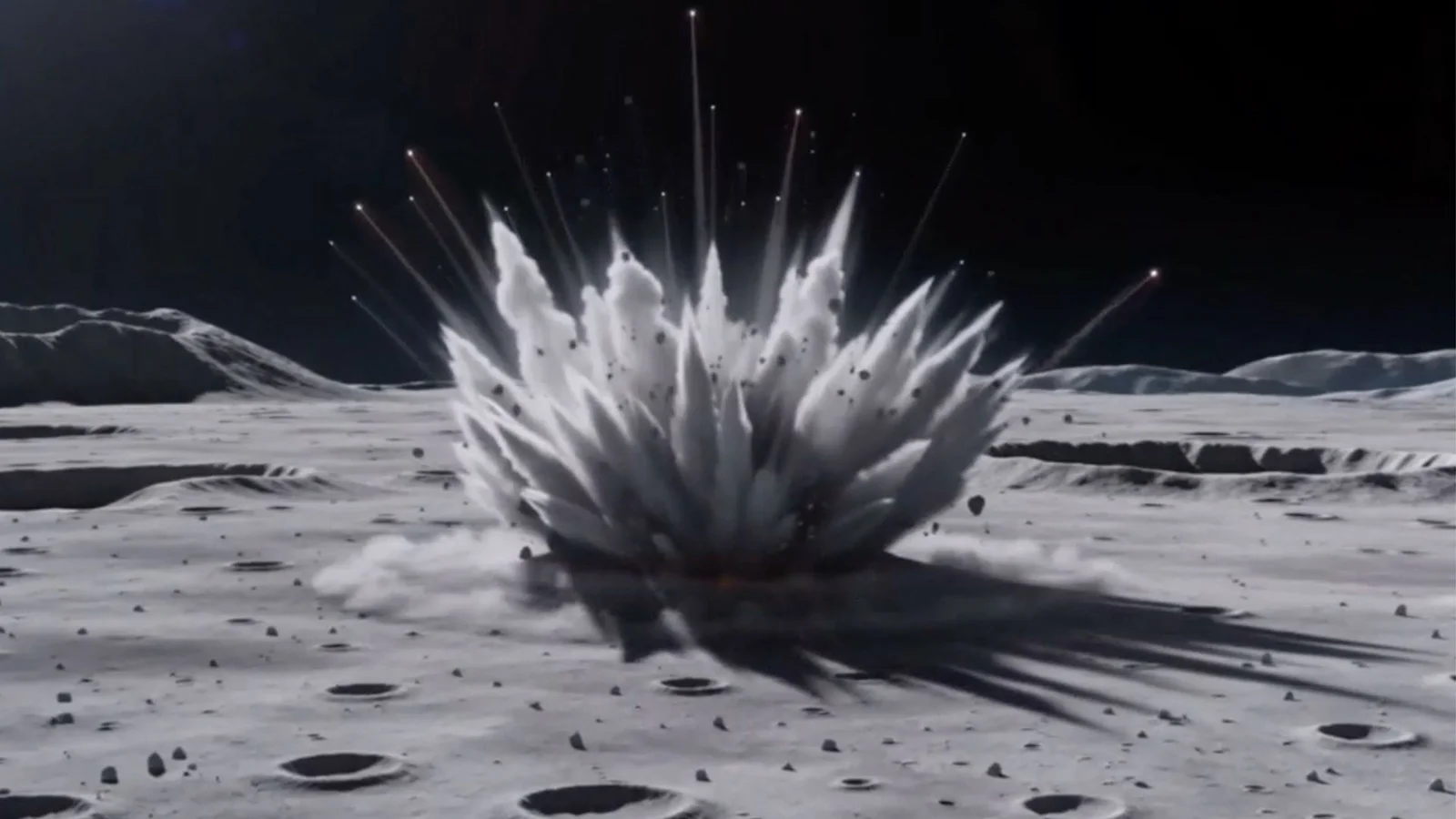
A High-Speed Kinetic Collision Near Einstein Crater
Space junk has reached deep space, and the Moon is taking the hit. The upper stage of a SpaceX Falcon 9 rocket, left drifting in orbit after fulfilling its mission in 2025, has finally succumbed to gravitational tugs and is slamming into the lunar surface on 5 August 2026. Moving at roughly 2.4 kilometers per second, the discarded cylinder acts like an artificial meteorite slamming into an airless world.
The impact site sits near Einstein crater, located on the far western limb of the Moon. Because the Moon lacks an atmosphere to slow down incoming objects, the rocket stage will experience no friction or heating before impact, transferring all its kinetic energy directly into the lunar crust upon contact.
The Physics of an Artificial Lunar Impact
Uncontrolled rocket stages hitting the Moon are rare but informative natural experiments for planetary geologists. Analyzing how a human-made object of known mass and speed excavates lunar regolith provides vital data for understanding cosmic impact dynamics.
- Vehicle mass: The empty aluminum alloy structure weighs approximately 4 metric tons (9,000 pounds).
- Impact speed: Traveling at 8,690 km/h, the rocket releases energy equivalent to several tons of TNT.
- Crater dimensions: Computer models predict the impact will dig a crater roughly 18 meters wide and 3.6 meters deep.
What the Ejecta Plume Reveals for Future Lunar Bases
While stargazers on Earth cannot see the impact directly with the naked eye, orbital reconnaissance craft and ground-based telescopes are tracking the resulting dust cloud. Researchers led by William Jo modeled the ejecta column density, predicting a plume of pulverized dust and rock that shoots dozens of kilometers above the surface before settling back down.
This debris plume offers planetary scientists a temporary window into subsurface lunar geology without launching a drill mission. By observing how ejecta scatters and measuring crater formation mechanics, space agencies gain practical data for sitting future lunar outposts away from high-risk impact zones and understanding the structural integrity of the lunar crust.