 EVERYTHING


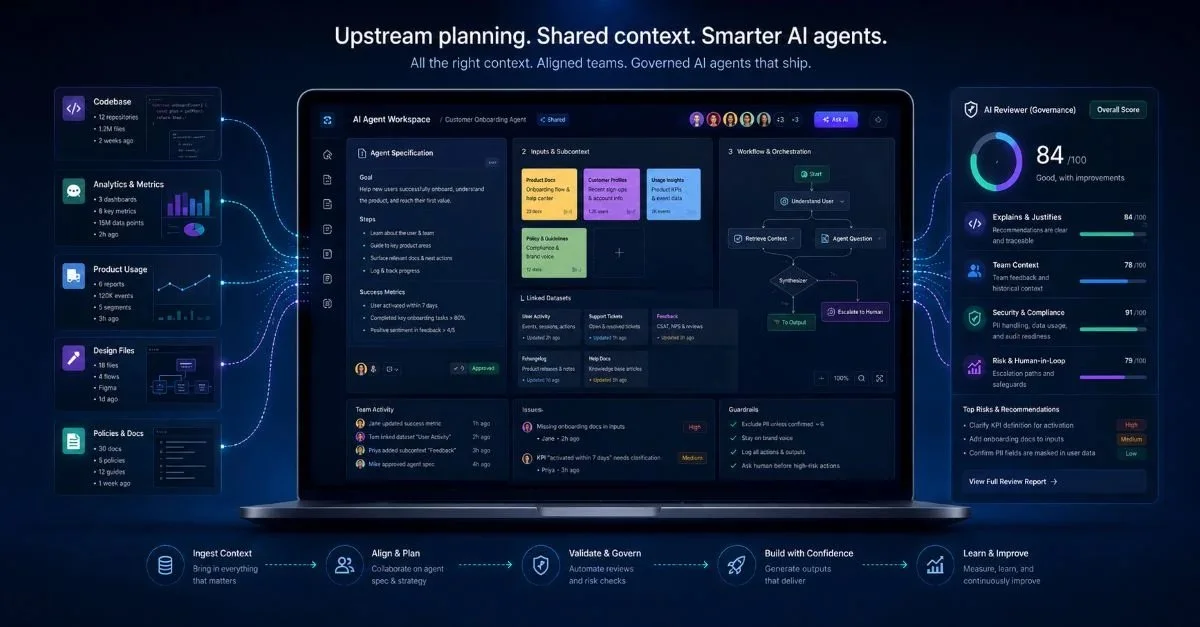
According to Devops, Allstacks has integrated Product Studio into its software engineering intelligence platform, providing teams with a centralized environment to draft and refine requirements for artificial intelligence (AI) agents. This tool leverages existing data within the SaaS application platform—including relationships between codebases, delivery history, customer feedback, and strategy documents—to give specifications crucial institutional context.
Shifting Development Upstream with AI Review
The platform also features an adversarial AI reviewer tool that assesses every specification against several critical metrics before a project launches. These checks include engineering feasibility, team capacity, security standards, and historical rework rates. Hersh Tapadia, CEO of Allstacks, noted that Product Studio enables teams to design AI agents much further upstream in the development lifecycle. He emphasized that iterative development of autonomous, machine-speed AI agents is not truly feasible if quality control is left until later stages.
Tapadia stated that the specifications collaboratively defined for these AI agents are now the most crucial phase of software development. Weak initial specifications inevitably lead to weak code, which results in production instability and significantly higher costs downstream. This issue is compounded by the memory limitations inherent in current AI coding tools; the more application environment information they process, the less memory remains available for reasoning about the agent's actual development.
Providing Context to Overcome Memory Constraints
Product Studio solves this challenge by allowing DevOps teams to expose AI coding tools to a rich context. This eliminates the need for developers to repeatedly reload vast amounts of application data every time an AI coding tool is used to build or refine an agent. In essence, Product Studio furnishes AI coding tools with the necessary institutional knowledge, creating a reliable harness for building agents more efficiently.
Mitch Ashley, vice president and practice lead for software lifecycle engineering at the Futurum Group, highlighted the necessity of re-engineering how specifications are created and integrated in this new era of AI-native development. When agents plan, orchestrate, generate, and act at machine speed, the emphasis must shift from mere code execution to intent. Ashley pointed out that teams who defer verification until the pull-request stage will absorb massive rework debt when scaled up by autonomous agents.
- The obligation now lies in instrumenting feasibility, capacity, and security checks during the specification phase itself.
- Teams must ensure that original prompts adequately communicate their intended meaning within the broader application context.
- This proactive approach prevents weak specifications from translating into poorly performing deployed code.
Ultimately, while the rise of AI is accelerating the need for specialized software engineering intelligence platforms, the fundamental challenge remains how much contextual information is enough to guide these powerful new systems effectively.
The integration of tools like Product Studio signals a major evolution in the relationship between product development and traditional software engineering practices as organizations embrace autonomous AI agents.