 EVERYTHING


Micro-Fossil Discovery in South China's Cambrian Rocks
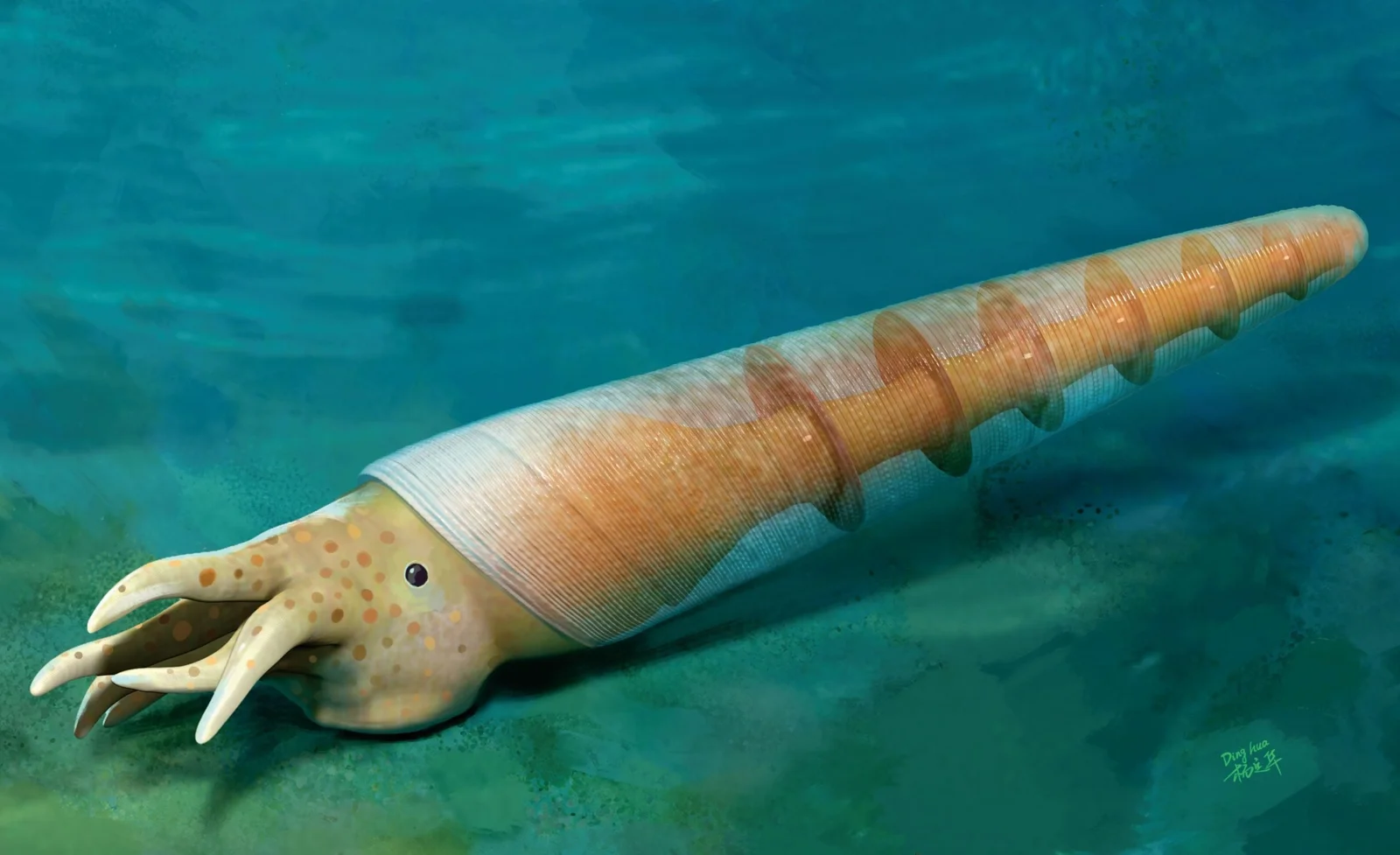
Paleontologists examining tiny shell fragments from the Shuijingtuo Formation in Shaanxi, South China, identified 32 fossilized specimens of a previously unknown organism named Eoceras shaanxiense. Using scanning electron microscopy and high-resolution micro-computed tomography, researchers mapped the internal anatomy of these millimeter-scale, cone-shaped shells preserved in phosphate minerals.
The microscopic fossils date back approximately 520 million years, placing them squarely in the early Cambrian period. This timeframe bridges a long-standing gap between genetic estimates of cephalopod origins and the earliest known physical specimens.
How a Millimeter-Scale Siphon Powered Ocean Lift
To understand how Eoceras moved, imagine a submarine filling and emptying its ballast tanks to control depth. Inside its tiny cone shell, Eoceras ran a narrow, segmented internal tube called a siphuncle across a series of interior chambers. Tiny capillary-like canals pierced the chamber walls, allowing the creature to pump water out and replace it with gas to adjust its weight in the water column.
Detailed structural imaging revealed several defining characteristics of this ancient buoyancy system:
- An orthoconic, straight cone-shaped shell measuring only a few millimeters across its widest opening.
- A continuous internal siphuncle anchored along the ventral underside of the shell casing.
- A series of delicate interior septa divided into distinct gas-holding chambers connected by micro-canals.
- A primitive, partially enclosed tube structure preceding the reinforced connecting rings found in later marine species.
Before this find, the oldest accepted siphuncle belonged to Plectronoceras cambria, a fossil roughly 30 million years younger. Finding a functional siphuncle in early Cambrian strata confirms that buoyancy control evolved much faster than traditional fossil timelines suggested.
Seabed Hovering Set the Stage for Deep Ocean Conquest
Although Eoceras mastered the basics of floating, its primitive anatomy kept it tethered to shallow waters. Without the reinforced septal necks and high-pressure fluid pumps seen in later ammonites, this ancient organism could not withstand the crushing pressure of deep ocean trenches. Instead, it operated like an underwater hovercraft, drifting just inches above the seafloor to dodge seabed predators while conserving energy.
This evolutionary stepping-stone explains how modern cephalopods eventually abandoned hard outer shells altogether. By perfecting internal fluid management inside tiny cones like Eoceras, ancient ancestors paved the way for squids and octopuses to swap heavy armor for rapid jet propulsion, reshaping marine ecosystems for the next half-billion years.