 EVERYTHING


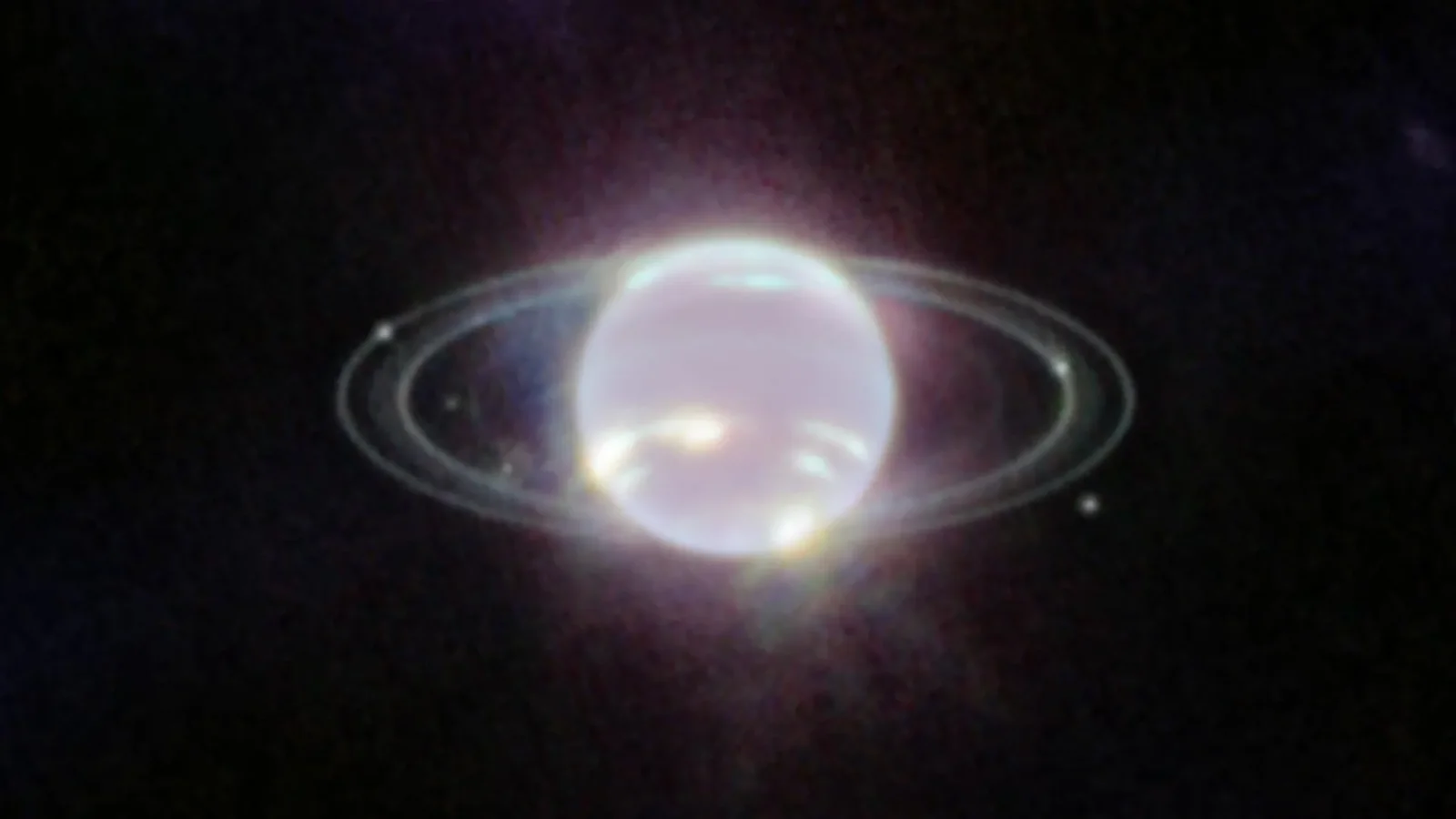
Webb Detects Warm-Water Clays Around Neptune
Using the Near-Infrared Spectrograph on NASA's James Webb Space Telescope, planetary scientists at Caltech analyzed light reflected from Neptune's faint rings and small inner moons, including Larissa, Galatea, and Proteus. The spectral data produced a stark anomaly: clear signatures of magnesium-rich phyllosilicates, commonly known as clay minerals.
Phyllosilicates form when rocky material sits in liquid water over long periods. Finding these minerals in the frozen reaches of Neptune—where surface temperatures hover near minus 220 degrees Celsius—defies standard models of outer solar system chemistry.
A Complete Mismatch With Local Deep-Freeze Conditions
In the outer solar system beyond Jupiter, planetary bodies are dominated by water ice, frozen methane, and volatile organics. Small satellites like Larissa and Galatea, measuring only a few dozen kilometers across, lack the internal gravitational mass to retain decay heat or support liquid water interiors.
According to the team's paper published in Science Advances, the spectral findings presented several distinct anomalies that baffled researchers:
- Neither Larissa nor Galatea displayed detectable surface water ice in their near-infrared spectra, despite containing hydrous clays.
- Small ring moons are far too small to generate internal heating, meaning the clay minerals could not have cooked inside the moons as they exist today.
- Proteus, the largest of Neptune's inner satellites, lacks the phyllosilicate signature entirely, suggesting a different origin or subsequent heating event.
Former Caltech researcher Ryleigh Davis noted that phyllosilicates had never been detected beyond Jupiter. The presence of water-altered rock on tiny moons pointed toward material formed deep inside a much larger planetary body.
Remnants of a Lost World Turned Inside Out
The presence of exposed mantle-like clays provides evidence for an ancient cosmic collision. Planetary scientists suspect Neptune originally possessed a regular family of icy moons similar to Uranus. That order vanished when Neptune gravitationally captured Triton, a massive dwarf planet originating from the Kuiper Belt.
Triton's disruptive entry plunged the original moon system into chaotic orbits, causing large icy satellites to smash into one another. Heat from radioactive decay inside those original large moons had already melted core ice and baked surrounding rock into phyllosilicates. The violent collision shattered the ancient worlds, scattering their deep interiors into space before roughly 1 percent of the debris reassembled into the tiny inner moons visible today. The catastrophic event effectively turned Neptune's ancient satellite system inside out.