 EVERYTHING


An Unfinished Monster Telescope Stumbles Upon an Accidental Breakthrough
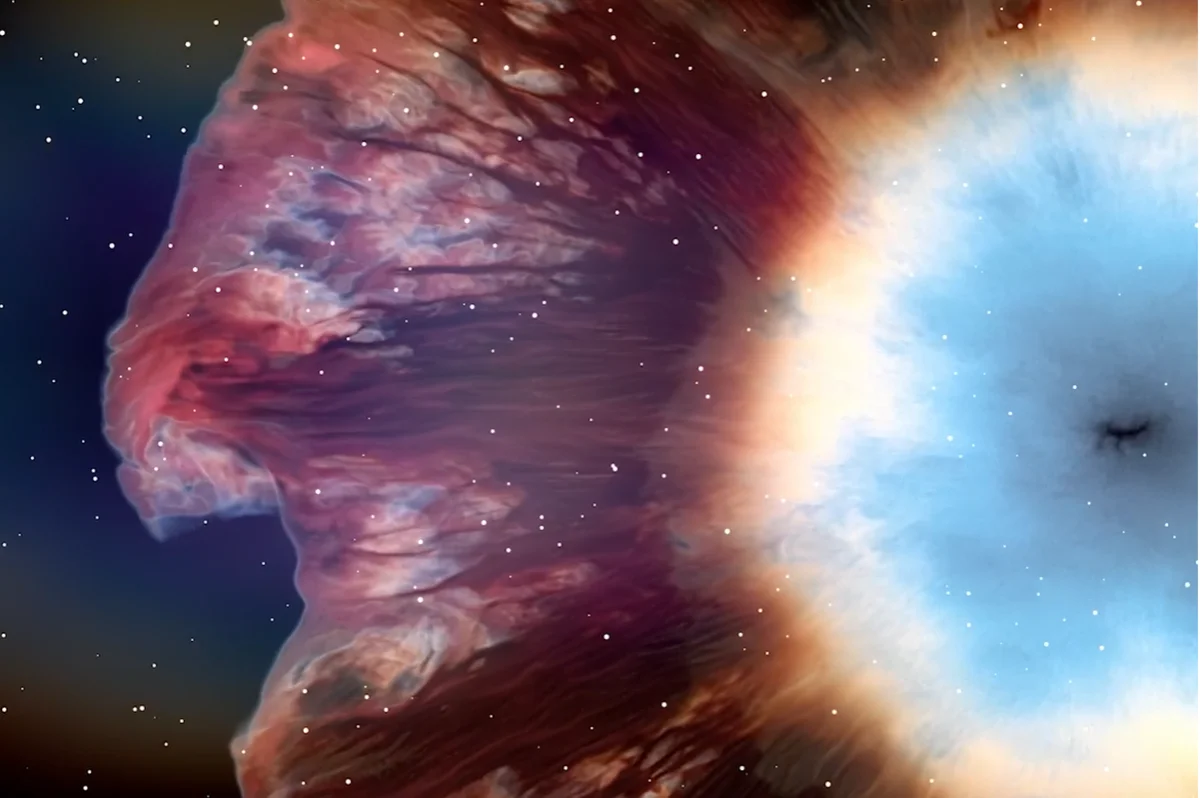
In November 2025, Yale University astronomer Pieter van Dokkum pointed an incomplete instrument at the Helix Nebula for a routine hardware test, expecting nothing more than a standard calibration image. Instead, his team captured 22 glowing, crescent-shaped bow shocks tearing through the outer halo of the nebula, roughly 650 light-years from Earth in the constellation Aquarius.
The findings, published in the journal Nature on 12 August 2026, document the precise boundary where a dying star’s ejected material slams into cold interstellar gas. Like cosmic shrapnel blasted outward at extreme speeds, these dense fragments of stellar debris are caught in the act of disintegrating into raw space dust.
Why Capturing Gas Shrapnel Requires 1,140 Sports Camera Lenses
Traditional observatories like the Hubble Space Telescope or the James Webb Space Telescope are designed like high-powered microscopes, peering into tiny patches of the sky with intense magnification. However, sweeping outer halos like that of the Helix Nebula are extremely faint, diffuse, and wide—covering an area nearly as large as the full moon.
To overcome this hurdle, van Dokkum and co-author Roberto Abraham from the University of Toronto designed MOTHRA (Modular Optical Telephoto Hyperspectral Robotic Array). Installed at the El Sauce Observatory in Chile’s Rio Hurtado Valley, the instrument bypasses traditional mirrors altogether. Its technical footprint relies on a unique design:
- An array of 1,140 Canon 400mm f/2.8 telephoto lenses mounted on 30 motorized platforms.
- Specialized nano-coated anti-reflection glass that eliminates internal light scattering inherent to mirror-based systems.
- Custom tilt-filter technology from Iridian Spectral Technologies that isolates ionized hydrogen-alpha light at a sharp 656-nanometer wavelength.
Even though MOTHRA operated with less than a fifth of its planned optics during the observation, a 2-hour exposure captured details that had eluded major observatories for decades.
The 10,000-Year Clock That Explains How Dead Stars Build New Worlds
Before this observation, astrophysicists understood that red giants expand, cast off their outer layers, and leave behind planetary nebulae, but the exact timeline of element mixing remained purely theoretical. The MOTHRA data revealed that individual gas clumps race outward at speeds between 35 and 45 kilometers per second before completely eroding into the interstellar medium within roughly 10,000 years.
This rapid destruction rate acts as a cosmic hourglass. As these speeding gas bullets dissolve, they inject heavy elements like carbon, nitrogen, and oxygen into interstellar space. These released elements form the chemical foundation for future molecular clouds, new stellar nurseries, and eventually rocky planets. In roughly 5 billion years, our own Sun will undergo this exact same recycling process, hurling its own elemental shrapnel out into the galaxy to seed stars that have not yet been born.