 EVERYTHING


Sediment Cores Uncover a Million-Year Ocean Anomaly
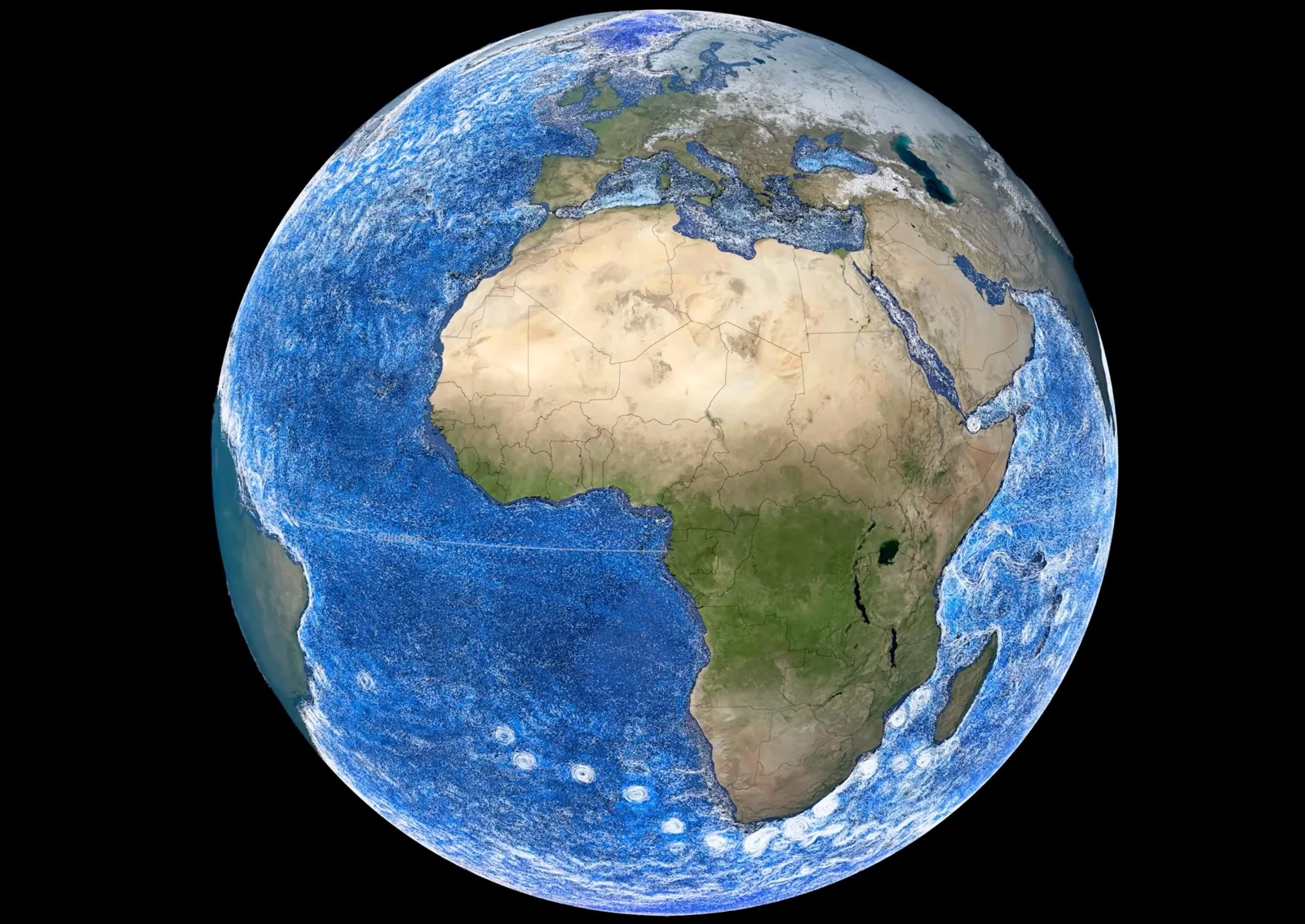
In a study published in Nature Geoscience, paleoceanographer Dr. Suning Hou and an international research team analyzed deep-sea sediment cores drilled at Site U1475 on the Agulhas Plateau, located 500 kilometers south of South Africa. The team investigated the late Pliocene epoch, spanning 3.6 to 2.6 million years ago, to see how ocean currents reacted as Earth transitioned from a warm climate into a glacial cooling phase.
Microscopic Fossils Map the Shifting Southern Currents
To reconstruct ancient oceanic flow, researchers examined microscopic plankton fossils called dinocysts and organic lipid biomarkers preserved in seabed sediment layers. These biological traces allowed scientists to track the precise position of the Southern Ocean subtropical front, a gateway controlling how much salty water leaks from the Indian Ocean into the Atlantic around the tip of Africa.
When the subtropical front moved northward around 3.4 million years ago, local surface waters cooled by 3 degrees Celsius, throttling the Indian Ocean salt pipeline near to a complete shutdown. Under standard oceanographic theory, losing this heavy salt injection should have weakened the Atlantic Meridional Overturning Circulation (AMOC)—the massive planetary conveyor belt that draws warm surface waters north and plunges cold water into the deep ocean.
- Deep-sea sediment cores recovered from the Agulhas Plateau provided a million-year timeline of Indian-Atlantic water exchange.
- Microscopic dinoflagellate cysts served as living thermometers to map past shifts in ocean boundaries.
- Seafloor lipid biomarkers confirmed that local surface waters cooled sharply during the Pliocene glacial cooling phase.
A Planetary Plumbing Disconnect Challenges Climate Forecasting
Instead of slowing down, the Atlantic conveyor belt intensified. By comparing sediment samples from the Gulf of Mexico, the Caribbean Sea, and the equatorial Atlantic alongside high-resolution climate modeling, the team uncovered a basin-wide reorganization of the ocean thermocline. Deep-water formation in the North Atlantic surged despite the missing salt supply, proving that the causal link between Agulhas salt leakage and AMOC strength can decouple during major planetary shifts.
«The AMOC can remain strong even when Agulhas Leakage weakens,» explained Dr. Hou, noting that seeing the exact same pattern in both physical sediment archives and numerical simulations confirmed the ocean had reorganized on a basin-wide scale. As scientists monitor modern AMOC stability amidst accelerating polar meltwater, the discovery shows that planetary climate models cannot rely on single salt-injection drivers to predict how global currents will respond to future ocean warming.