 EVERYTHING


Dissecting the Genetic Relay Behind Floral Blooming
Every tomato harvest depends on a precise sequence of microscopic events inside the flower. Male and female reproductive organs must mature in unison, stamens must release pollen at the exact moment of readiness, and fertilization must occur before fruit development begins. When winter temperatures drop, this biological choreography breaks down: pollen viability plunges, flowers drop off, and plants stop producing fruit.
To tackle this bottleneck, a research team led by Prof. Naomi Ori and doctoral researcher Nave Man at The Hebrew University of Jerusalem targeted the plant's internal signaling network. Working alongside scientists from the Leibniz Institute of Plant Biochemistry and Israel's Volcani Institute, the team published their findings in New Phytologist after uncovering how two key genes, SlARF8A and SlARF8B, act as master regulators of floral synchronization.
Bypassing Pollination Through CRISPR Gene Editing
The researchers focused on the plant's response to auxin, a fundamental growth hormone. In natural conditions, a microRNA molecule designated as miR167 acts as a molecular brake to keep auxin-responsive genes in check. Using CRISPR gene editing, the team systematically adjusted both the accelerator genes and the microRNA brake.
This dual intervention unlocked a biological phenomenon known as parthenocarpy, where the plant initiates fruit growth automatically without requiring fertilization. The gene-edited plants demonstrated several key physiological shifts during greenhouse testing:
- Spontaneous creation of seedless tomatoes before natural pollination took place
- A compact plant structure that redirected metabolic energy away from excess leaves directly into fruit production
- Accelerated ripening cycles across all tested climate conditions
Redefining Winter Agriculture and Energy Efficiency
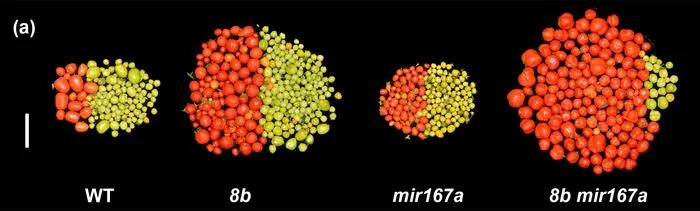
The most striking results emerged during unheated winter greenhouse trials. Under cold stress that left conventional tomato plants largely barren, the gene-edited variants produced 18 times more fruit in the early growing season. By final harvest, the modified crops yielded six times more individual ripe tomatoes and 10 times the total weight of edible fruit compared to unmodified controls.
While standard plants remained clogged with unripened green fruit, the modified crops turned deep red ahead of schedule. Beyond boosting raw harvest weight, removing the requirement for pollination solves a major economic hurdle for commercial agriculture. Heated greenhouses consume vast amounts of energy to maintain summer-like temperatures for pollen survival. By decoupling fruit growth from climate-sensitive pollination, farmers could soon cultivate high-yielding crops in colder regions with significantly smaller carbon footprints.