 EVERYTHING


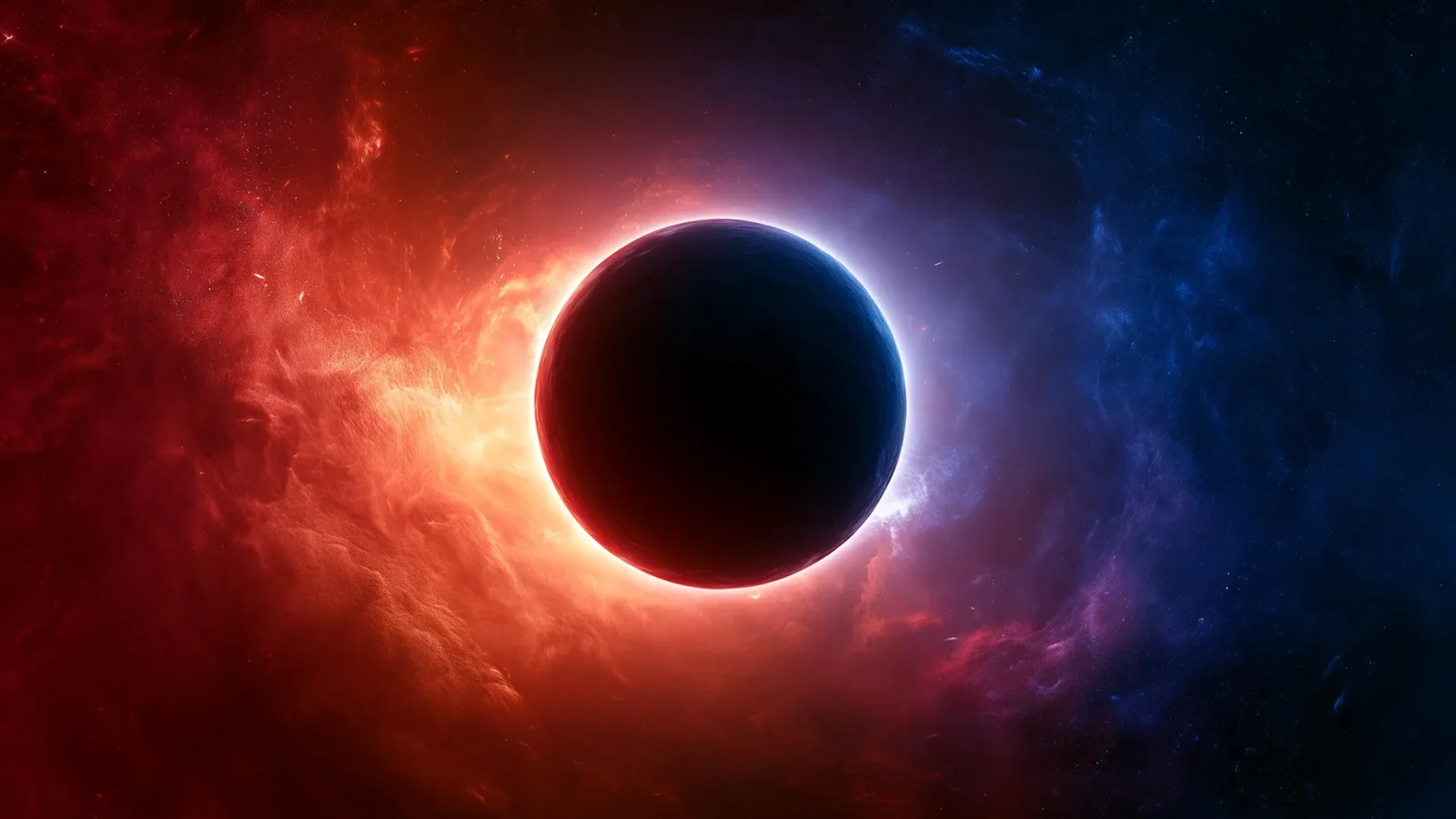
A Cosmic Reset Button Replaces the Singularity
On 11 August 2026, researchers led by Professor Enrique Gaztañaga at the University of Portsmouth presented a model that challenges the traditional picture of cosmic origin. Instead of space and time erupting from a single, infinitely dense point 13.8 billion years ago, the team modeled a cosmic bounce where a prior universe contracted and then expanded into our own.
How Objects Bigger Than 90 Meters Survived the Great Squeeze
Imagine compressing a giant rubber ball until its internal pressure forces it to rebound instantly. In bouncing cosmology, quantum pressure at extreme densities stops the collapse before an infinite singularity can form, triggering a rapid expansion.
The Portsmouth calculations revealed several key survival thresholds during this cosmic rebound:
- Compact objects larger than roughly 90 meters across possess enough gravitational binding energy to pass through the high-density bounce intact.
- Relic gravitational waves and primordial density fluctuations survived the transition, leaving distinct signatures in cosmic structure.
- Ultra-dense pockets collapsed into primordial black holes immediately following the expansion phase.
Solving Webb's Little Red Dot Puzzle
Recent observations from NASA's James Webb Space Telescope have baffled astronomers by revealing supermassive black holes and fully formed galaxies existing mere millions of years after the Big Bang. Standard cosmological models struggle to explain how such massive objects could assemble so quickly from scratch. If pre-existing black holes survived the bounce, they acted as ready-made seeds that accelerated galactic formation across the infant universe.
Ancient Black Holes May Be the Invisible Dark Matter
The climax of the discovery lies in what these ancient relics mean for the present day. Because dark matter outweighs visible matter by five to one yet remains completely invisible to telescope instruments, its physical identity has stumped physics for a century. The Portsmouth model demonstrates that if enough of these pre-Big Bang black holes crossed the bounce threshold, their combined gravitational pull would account for the entire missing mass of dark matter in the modern universe. Future measurements of cosmic microwave background radiation and primordial gravitational waves could soon confirm whether the invisible web holding our Milky Way together is made of fossils from a forgotten cosmos.