 EVERYTHING


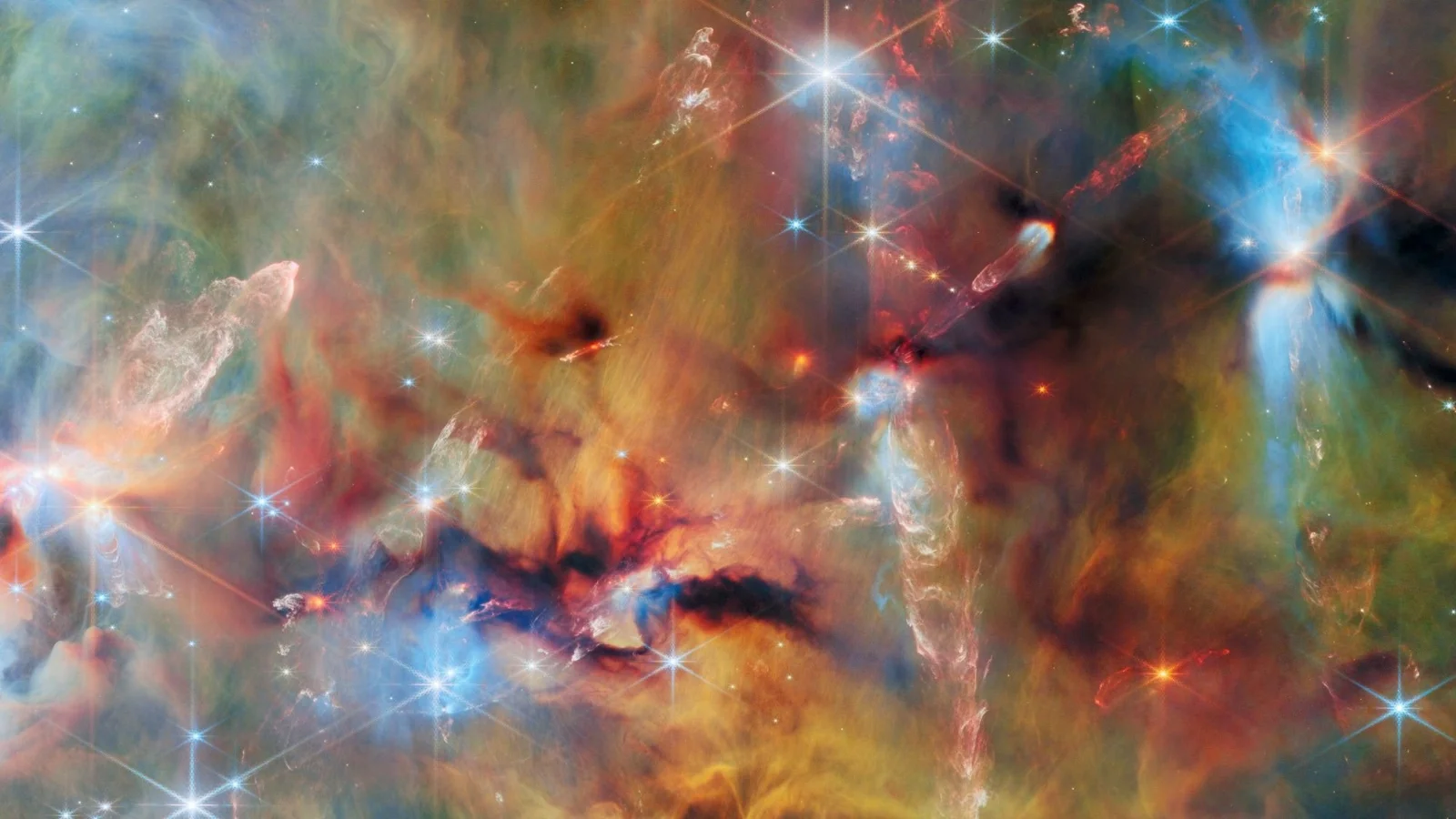
According to Livescience, the James Webb Space Telescope (JWST) has unveiled a vivid portrait of the OMC-2 molecular cloud. Located in the constellation Orion, this region serves as a massive cosmic nursery where gas and dust are actively collapsing to form new stars. The imagery captures the chaotic yet structured environment of stellar evolution, showcasing multiple stages of development simultaneously.
A landscape of cosmic creation
The OMC-2 cloud is situated just south of the famous Orion Nebula, a well-known landmark in the night sky. While many observers can see the nebula with basic telescopes, the JWST utilizes infrared vision to penetrate thick layers of dust that obscure visible light. This capability allows scientists to peer into the "cosmic cocoons" where embryonic stars are still gathering mass.
The visual data reveals a complex interplay of colors and textures:
- Blue, green, and yellow hues represent glowing layers of gas and dust.
- Dark brown and black clumps indicate dense pockets of cold dust that block all light.
- Orange, white, and blue points signify fully-formed stars of varying sizes shining through the haze.
Dynamics of protostar jets
One of the most significant features in the new imagery is a network of pale, glowing streams and wave-like structures. These formations are not static; they are created by protostar jets. As these young stars ignite, they release explosive beams of energy that collide with the surrounding material, carving out bright ridges and shock fronts.
These sculpted features provide critical data for researchers studying stellar dynamics. By observing how these jets reshape the cloud, astronomers can trace the movement of matter through the region. The image serves as a laboratory for understanding how gravity pulls material together while the resulting energy from new stars pushes it back out, creating a continuous cycle of cosmic recycling.
OMC-2 is one of four distinct parts of the Orion Molecular Cloud complex. While OMC-1 sits directly behind the nebula, OMC-2 and OMC-3 are located to its north, with OMC-4 positioned to the south. This comprehensive view helps scientists map the massive filaments that define our local galactic neighborhood.