 EVERYTHING


Microscopic Threads Weave Inside Cooling Crystal
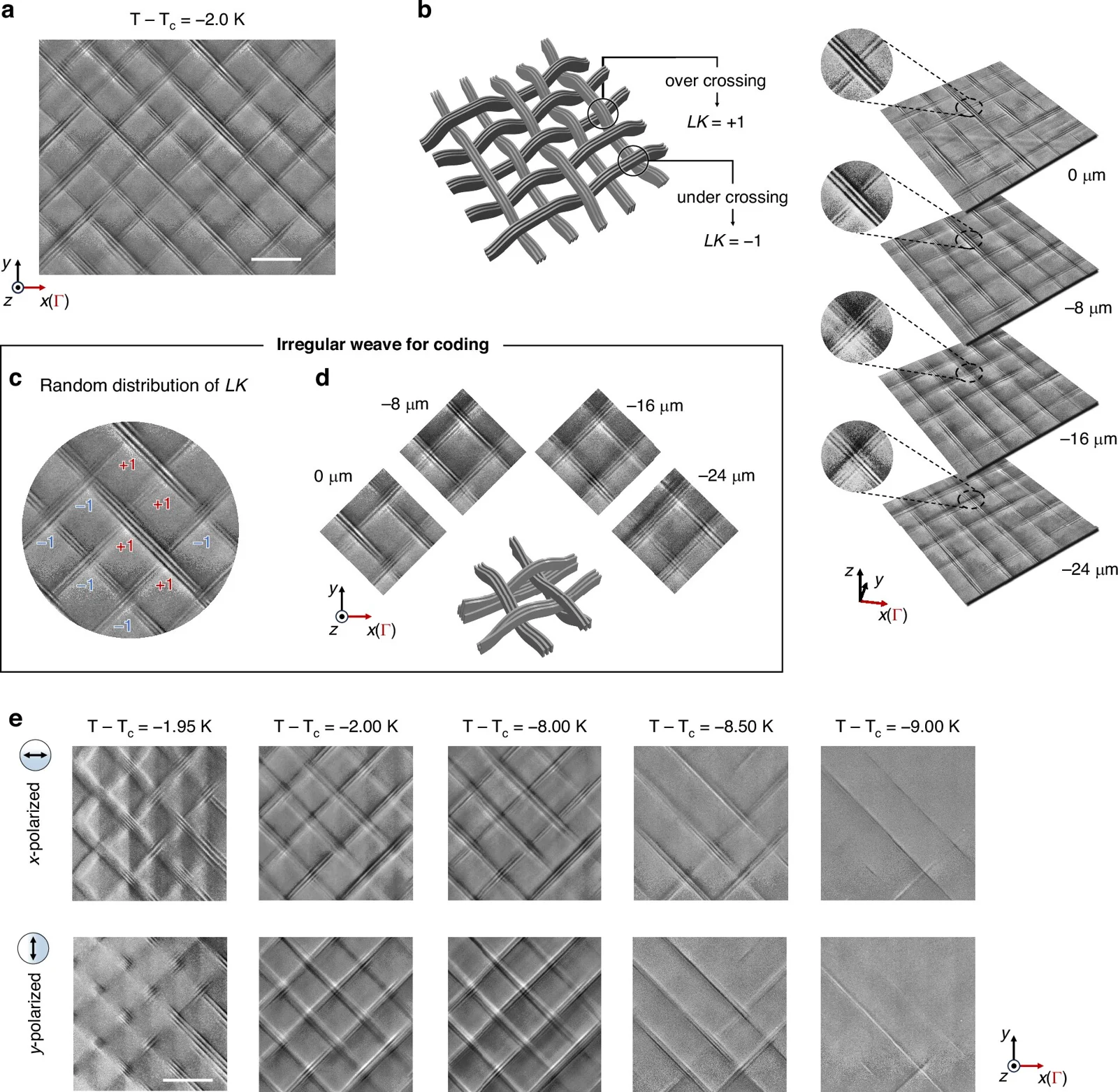
An international team of researchers from Sapienza University of Rome, Nankai University, and the Hebrew University of Jerusalem has observed a three-dimensional woven structure forming naturally inside a solid crystal for the very first time. As a specialized ferroelectric crystal composed of potassium lithium tantalate niobate (KTN:Li) cools through its phase transition temperature, its internal electric dipoles spontaneously organize into an intricate tapestry of interwoven nano-scale filaments.
In typical ferroelectric materials, cooling causes microscopic dipoles—the tiny electrical compasses inside the material—to align in flat, parallel blocks called domains. However, when the researchers examined the KTN:Li crystal under high-resolution optical imaging, they discovered that these dipole ensembles crossed over and under each other in three dimensions, replicating the structural topology of a woven textile fabric.
Targeted Lasers Untangle the Nano-Filaments
Beyond discovering this new structural phase of matter, the team uncovered a way to interact with the woven network using light. By aiming a tightly focused green laser at precise coordinates inside the crystal, researchers modified local sections of the pattern. The laser beam selectively untangles the woven dipole threads without altering or causing structural damage to the rest of the solid matrix.
This optical manipulation is fully reversible through thermal cycles. When the crystal is heated above its phase transition point and allowed to cool back down, the original woven domain fabric spontaneously rebuilds itself, creating a fresh, intact pattern across the material volume.
Spontaneous Symmetry Breaking Unlocks Next-Generation Optics
The discovery holds implications far beyond crystal physics because the three-dimensional fabric emerges via spontaneous symmetry breaking—a fundamental physical principle that governs phase transitions across diverse states of matter. Lead researchers, including Prof. Eugenio Del Re and Prof. Aharon J. Agranat, published their findings in Light: Science & Applications, pointing out that identical topological configurations likely exist undetected in liquid crystals, high-temperature superconductors, and exotic quantum substrates.
Because the woven domains can be locally erased with a laser and re-formed through cooling, they offer a natural, self-assembling platform for reconfigurable optical components. Instead of etching fixed electronic circuits into silicon through expensive lithography, future photonic devices could use light to write, erase, and rewrite complex 3D optical pathways inside self-woven solid crystals.