Science Read the original on Ars Technica 2 min read 0

Physicists Detect X(2370): A Particle Made of Pure Force, Not Matter

According to Ars Technica, physicists operating the Beijing Spectrometer III experiment have uncovered compelling evidence of an exotic subatomic particle long predicted by quantum theory. The candidate, known as X(2370), appears to be built almost entirely out of gluons—the force-carrying particles that normally glue standard matter together. The discovery could resolve a half-century-old puzzle about how the universe constructs fundamental mass.

#particle physics #glueballs #BES III #quantum physics #subatomic particles
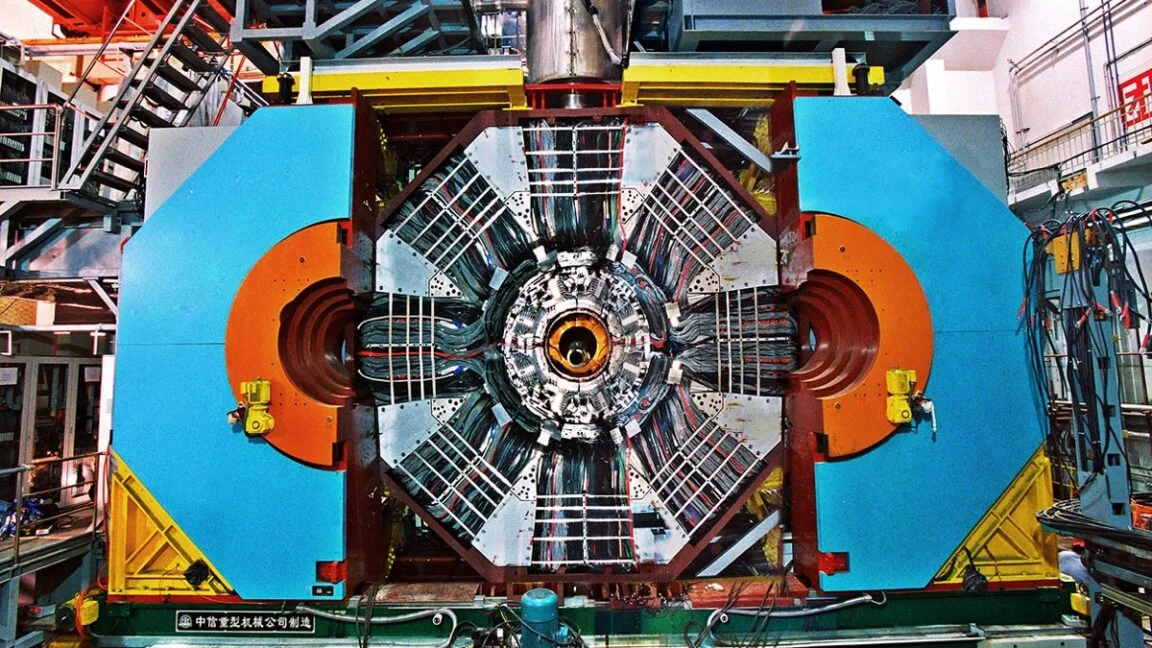
The Beijing Spectrometer III experiment facility provides new evidence for exotic glueball particles.
The Beijing Spectrometer III experiment facility provides new evidence for exotic glueball particles. · Image source: Ars Technica

Trapping Nature's Strongest Glue

Researchers analyzing data from the Beijing Spectrometer III (BES III) particle accelerator at the Institute of High Energy Physics in Beijing presented new measurements confirming that the subatomic particle X(2370) behaves like a theoretical glueball. While standard atomic matter consists of quarks held together by gluons, quantum chromodynamics predicts that gluons can stick to each other independently without any quarks present.

The discovery validates a core tenet of the Standard Model of particle physics that has eluded experimental physical confirmation for more than five decades.

Decoding the X(2370) Signature

In everyday atomic nuclei, protons and neutrons gain the vast majority of their mass not from static quarks, but from the binding energy of gluons interacting at high energy levels. A glueball represents a rare state formed almost purely out of this nuclear binding force, operating like cosmic Velcro in quantum mechanics.

Scientists identified several key experimental properties that set X(2370) apart from conventional composite hadrons:

  • A measured mass of 2.395 GeV/c², matching theoretical lattice quantum chromodynamics predictions with unprecedented precision.
  • A composite internal structure estimated to consist of roughly 90 percent force-carrying gluons.
  • Zero electric charge, neutral spin, and odd parity characteristics strictly demanded by fundamental quantum theory.

The Flavor Singlet Breakthrough

The final confirmation of the glueball hypothesis hinged on observing the decaying products of X(2370) following electron-positron collisions. Experimental data revealed that X(2370) functions as a flavor singlet, meaning its structural decay pathways show no bias toward any specific quark flavor such as up, down, or strange.

Colin Morningstar, a particle physicist at Carnegie Mellon University, observed that the dataset represents «the strongest evidence yet that particles dominated by a glueball component can exist in nature.» By proving that pure fundamental force can condense into localized composite particles, the BES III collaboration completes a half-century search and establishes a new empirical foundation for high-energy physics.

Why it matters

The verification of glueball states represents a major step forward for modern fundamental physics and materials science research. Understanding non-perturbative quantum chromodynamics allows scientific institutions and supercomputing centers to refine theoretical models that govern nuclear energy and high-energy physics. With facility upgrades planned at China's Institute of High Energy Physics and the upcoming Electron-Ion Collider at Brookhaven National Laboratory in the United States, experimental teams gain a verified benchmark for testing strong nuclear forces. These insights will help engineers improve particle accelerator diagnostics and advance high-precision detector technologies used across global research labs over the coming decade.

FAQ

What is a glueball in particle physics?
A glueball is a theoretical subatomic particle composed entirely of gluons, the force-carrying particles responsible for binding quarks together. Unlike standard protons or neutrons, glueballs contain no quarks and are formed from pure nuclear binding energy.
Why is the X(2370) particle discovery significant?
Discovered at the Beijing Spectrometer III experiment, X(2370) exhibits a measured mass of 2.395 GeV/c² and acts as a flavor singlet. It provides the strongest experimental evidence to date that bound states of pure gluons actually exist in nature.
How do gluons create mass without quarks?
Gluons themselves are massless particles, but the immense energy involved in binding them together creates mass according to Einstein's mass-energy equivalence equation. In glueballs, this binding energy accounts for virtually all of the particle's total mass.