 EVERYTHING


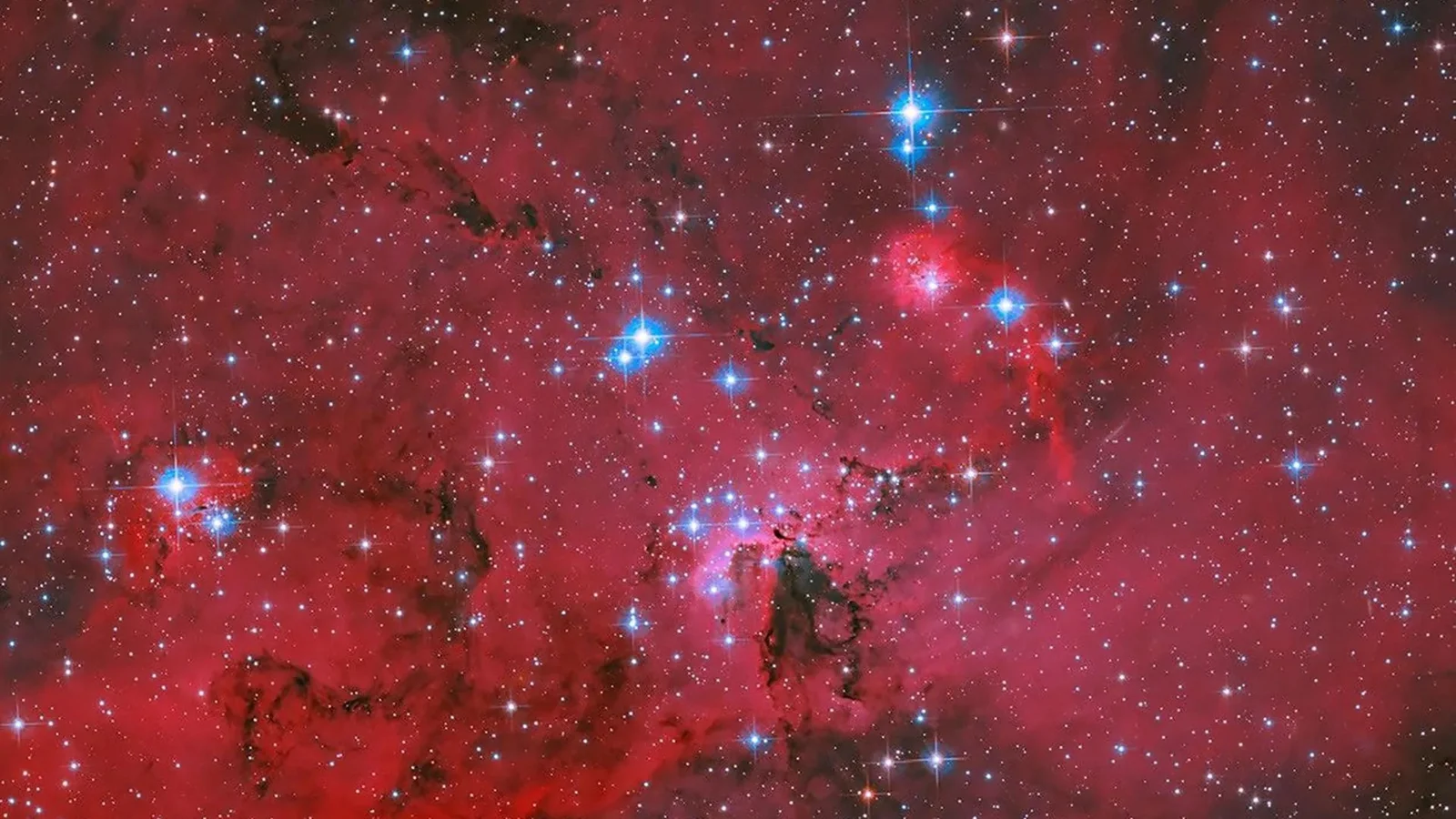
According to Sciencedaily, NASA's Hubble Space Telescope has provided a high-resolution view of LH 95, a sprawling star-forming region in the Large Magellanic Cloud. The imagery depicts a dramatic cosmic landscape where brilliant blue and white stars emerge from glowing crimson clouds of hydrogen gas. This celestial nursery serves as a primary laboratory for astronomers studying the early life cycles of stellar bodies.
Massive stars sculpting the nebula
The most prominent features in LH 95 are its massive blue giants, which possess at least three times the mass of our Sun. These energetic stars emit intense ultraviolet radiation and powerful stellar winds that actively heat and shape the surrounding hydrogen gas. While much of the nebula glows red due to hydrogen alpha emissions, thick lanes of dust remain dense enough to resist these forces, creating dark filaments that contrast against the vibrant background.
The visual data captured by Hubble represents specific wavelengths rather than a natural human view:
- Blue highlights represent shorter visible wavelengths.
- Red combines longer visible wavelengths with near-infrared light.
- Crimson glows indicate active hydrogen alpha emissions from new star formation.
Extended growth phases for young stars
One of the most significant findings from this observation is the identification of roughly 2,500 pre-main-sequence stars. These objects have gathered nearly all their necessary mass but have not yet ignited nuclear fusion in their cores. Researchers observed that these stars continue to shrink under gravity while drawing in material from birth disks for a longer duration than previously estimated.
The data confirms that the accretion rate—the speed at which a star gathers material—slows naturally as it ages, but this process can persist for several million years. This discovery refines current models of stellar development by showing that stars build their final mass more gradually before transitioning into fully fledged stars.
A multi-generational cosmic nursery
LH 95 is notable because it does not produce stars in a single, isolated burst. Instead, it hosts multiple generations of stars living side by side, indicating sustained formation over an extended period. For instance, the region's most massive star, located near the top left of the center, contains between 60 and 70 times the mass of the Sun. Despite its size, this giant is approximately one million years younger than many of its neighbors, illustrating the complex timeline of stellar birth within a single nursery.
These observations provide a clearer picture of how surrounding disks evolve and eventually dissipate as stars reach maturity. By studying these thousands of developing objects, scientists can better map the transition from collapsing gas clouds to stable celestial bodies.