 EVERYTHING


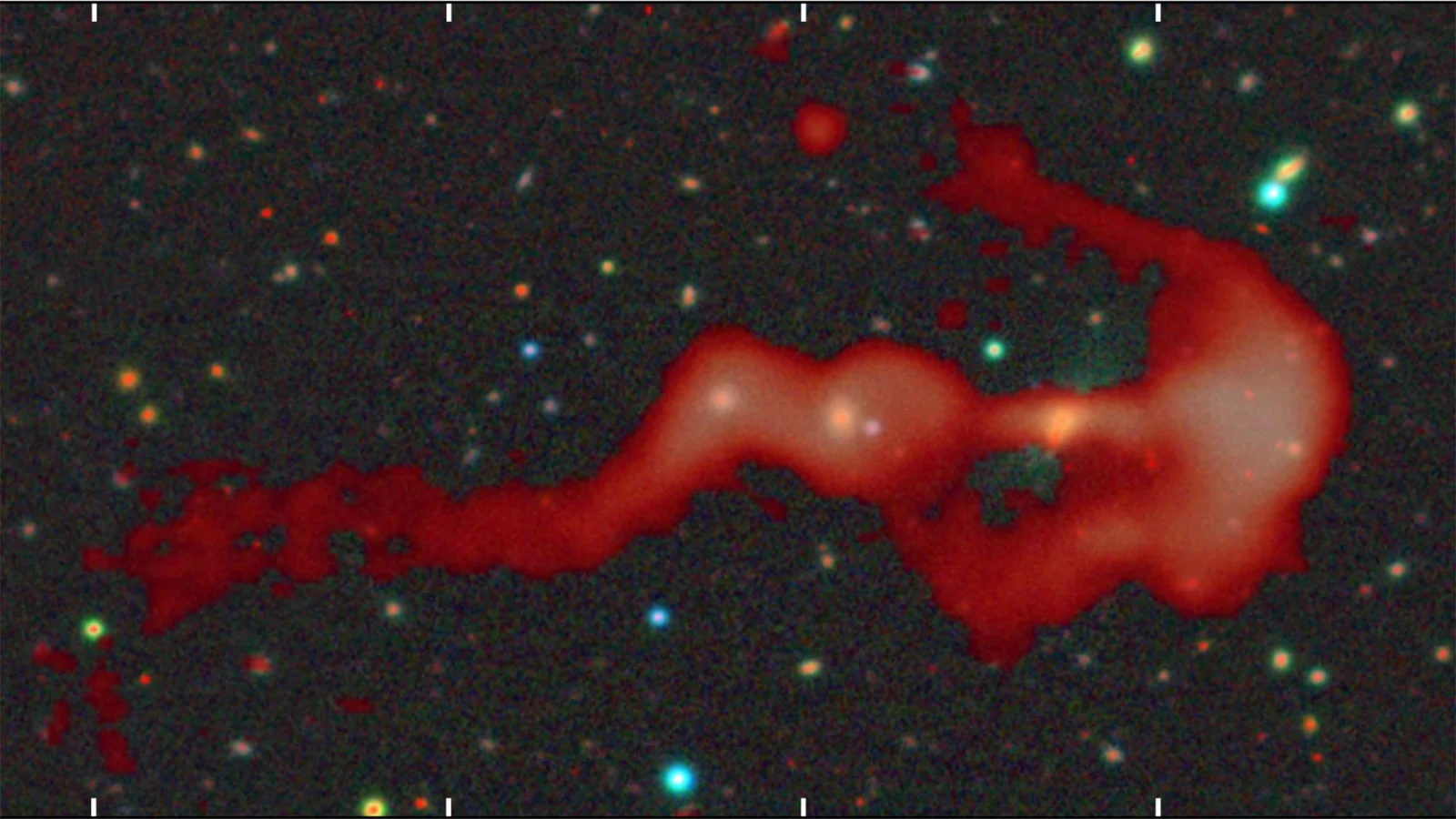
According to Livescience, researchers have unveiled a remarkable celestial structure dubbed the RAD-Bow-And-Arrow Radio Galaxy (RAD-BAARG). This discovery offers a rare direct view of a galaxy plunging into the environment of a galaxy cluster, showcasing extreme physical interactions on a cosmic scale.
A unique lopsided structure
Most radio galaxies are powered by actively feeding supermassive black holes that launch high-speed jets of charged particles in opposite directions. Typically, these jets create symmetrical lobes of magnetized plasma as they crash into the surrounding medium. However, RAD-BAARG stands out as an anomaly due to its lopsided and asymmetrical appearance.
The galaxy was first identified by citizen scientist Pranim Limbo while inspecting ultrasensitive radio images from the LOFAR Two-metre Sky Survey. The discovery was made through India's RAD@home Astronomy Collaboratory, a project involving an international team of researchers. The final image combines red radio emissions captured by the LOFAR telescope with optical data from the Beijing-Arizona Sky Survey.
The physics of cosmic bow shocks
Researchers believe the galaxy's peculiar shape is dictated by its movement through the intracluster medium—the hot, thin gas filling the space between galaxies. As RAD-BAARG falls toward a nearby cluster, it moves faster than the speed of sound within that gas, creating a shock front similar to a fighter jet's sonic boom.
The study highlights several key features of this interaction:
- One jet strikes the compressed wall of gas directly, bending into a bow shape nearly 1.8 million light-years across.
- The opposite jet faces less resistance, twisting into a distorted S shape that fades into a tail resembling an arrow.
- The total length of RAD-BAARG is approximately 2.3 million light-years, classifying it as a "Giant Radio Galaxy."
A rare observational milestone
While astronomers have long predicted that infalling galaxies would generate bow shocks, capturing such an event has been historically difficult. "The structure of this source is unlike that of any radio galaxy I have seen in the last 25 years," — Ananda Hota, principal investigator of the RAD@home Astronomy Collaboratory and first author of the paper, said in a statement. This discovery provides critical data on how galaxies evolve and interact with their larger environments.