 EVERYTHING


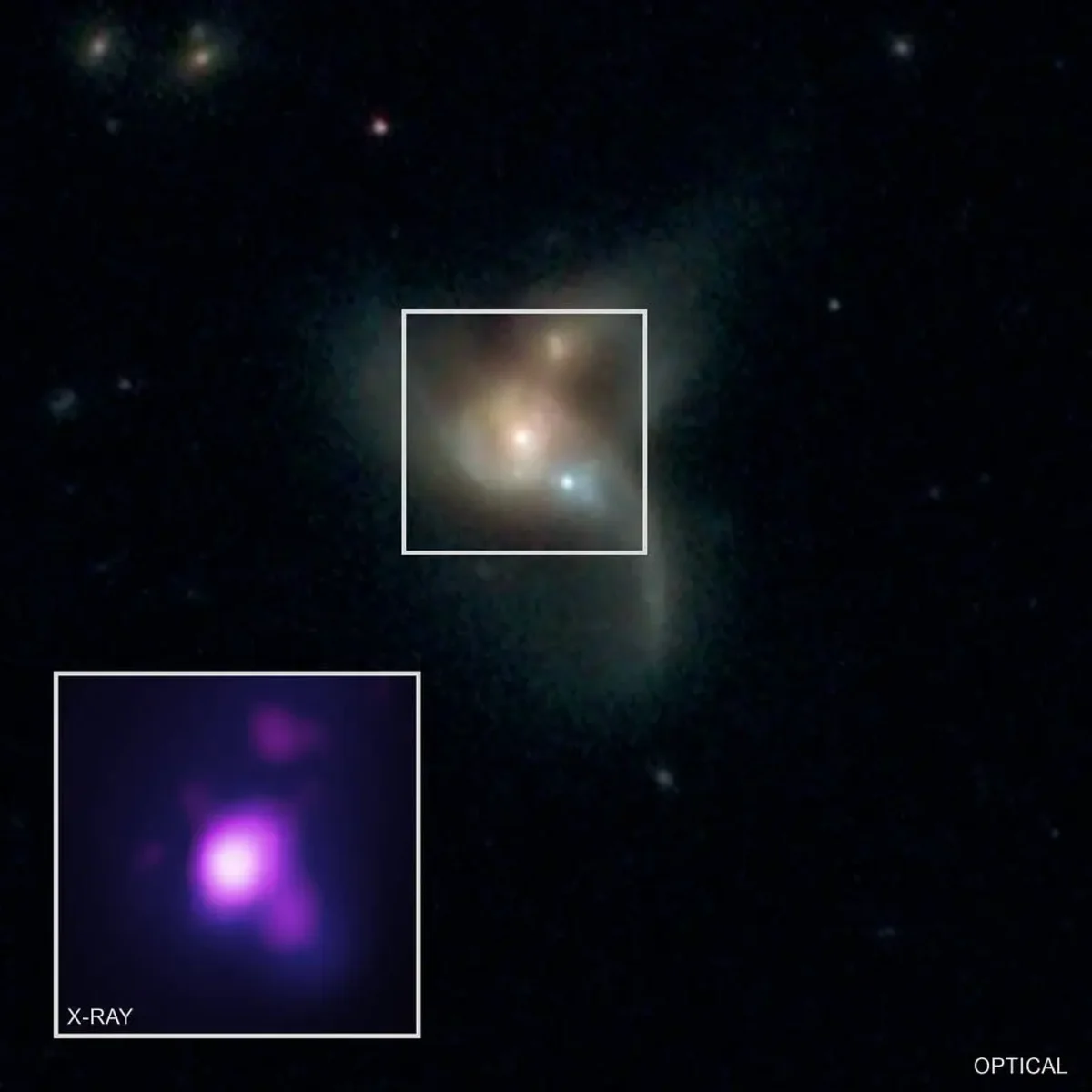
A Cosmic Crowded House 12.5 Billion Light-Years Away
The galaxy known as J0148-4214 formed just 1.2 billion years after the Big Bang, making it a cosmic newborn. Yet inside its borders, astronomers led by the Max Planck Institute for Extraterrestrial Physics discovered not one, but three distinct supermassive black holes simultaneously devouring nearby gas and dust.
To put that scale into perspective, imagine squeezing three supertankers into a small suburban pond. Two of these gravitational leviathans share the galaxy's central core at a distance of just 620 light-years from each other, while the third orbits further out in the galactic suburbs, roughly 5,500 light-years away.
Three Monsters of Drastically Different Sizes
What makes this cosmic family even stranger is that the three black holes are not equal partners in size or appetite:
- The primary titan boasts a mass equivalent to 80 million Suns, anchoring the center of the galaxy.
- The secondary companion weighs in at roughly 2 million solar masses, orbiting close to the primary.
- The junior outer member holds about 630,000 solar masses, making it the lightest of the group.
Despite being the smallest, the junior black hole turns out to be the most aggressive eater. It is consuming surrounding material at a rate exceeding the theoretical Eddington limit — essentially gorging on gas faster than light pressure can push the food away. As Dr. Hannah Übler noted during the announcement, «This is the first evidence of three active black holes in a single galaxy in the distant Universe.»
Untangling Overlapping Signals with Spectro-Astrometry
Detecting two central black holes parked so close together seemed optically impossible, as they sit six times closer than the sharpest visual resolution of the telescope. Standard observatories would have seen only a single, messy light source and misidentified it as one odd-looking black hole.
Astronomers solved this optical illusion using a technique called spectro-astrometry with NIRSpec. By breaking the light into distinct spectral slices and mapping where each wavelength peaked, researchers disentangled the overlapping light signatures. This technique confirmed that two separate objects were moving at different speeds within the galaxy's center, while confirming that the outer object was not a supernova shockwave.
Bypassing the Last-Parsec Problem for Future Space Detectors
This crowded dynamic solves one of astrophysics' biggest headaches: the «last-parsec problem.» Normally, when two black holes approach each other after a galaxy collision, they stall out at short distances because there are not enough surrounding stars to drain their orbital energy. Adding a third heavy body acts like a gravitational slingshot, kicking energy out of the system and forcing the inner pair toward a rapid final merger.
Astrophysicists calculate that the smaller central black hole will spiral into the primary leviathan over 660 million years. Meanwhile, the outer black hole's eventual merger with the core carries an 81.8 percent probability of being captured by LISA, the Laser Interferometer Space Antenna set to launch around 2035. By witnessing this triple system today, scientists finally have direct proof of the rapid merger cascade that built the universe's most massive black holes.