 EVERYTHING


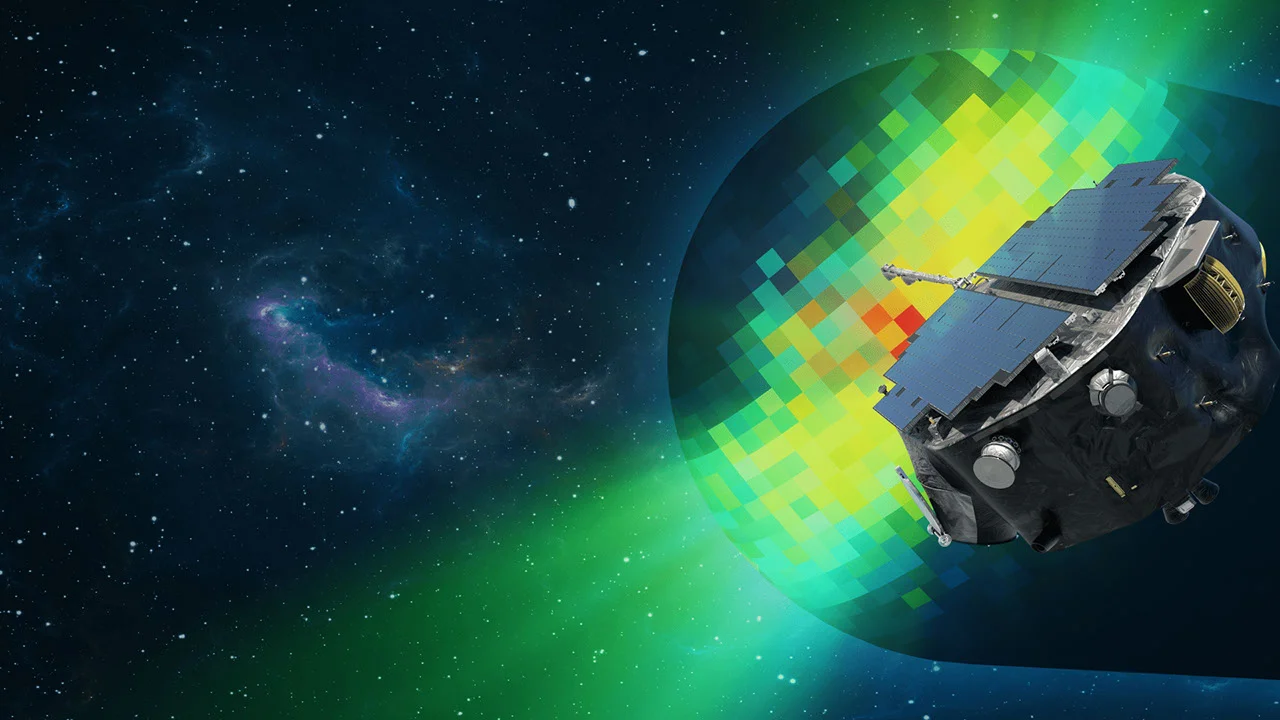
Data Access Opens for NASA’s Deep Space Scout
Scientific telemetry collected through 30 April 2026 from seven payload instruments is now accessible via the Space Physics Data Facility and Princeton University. Floating roughly one million miles from Earth toward the Sun, the spacecraft operates at Lagrange Point 1, capturing particles before they collide with Earth's magnetosphere.
The probe acts like a cosmic weather station parked in deep space. By sampling the constant flow of solar wind and interstellar dust, it records how high-energy particles interact at the outermost boundary of our solar neighborhood.
Seven Sensors Tracking Solar Wind and Interstellar Dust
The released telemetry includes detailed particle counts, magnetic field vectors, and radiation measurements gathered during the probe's first operational quarter. Researchers can now analyze raw data streams captured by diverse instrument packages built by international scientific partners:
- MAG: Measures interplanetary magnetic fields generated by the Sun to track magnetic storm dynamics.
- SWAPI: Detects solar wind ions alongside neutral interstellar particles entering from deep space.
- HIT: Analyzes high-energy ions accelerated by solar flares and cosmic ray activity.
- GLOWS: Observes ultraviolet light emissions to map how solar wind structures evolve over distance.
- SWE: Tracks thermal and suprathermal electrons flowing outward from the solar corona.
- CoDICE: Measures the exact mass and electrical charge of ions across low and medium energy spectrums.
- IDEX: Captures individual microscopic dust grains arriving from interstellar space to determine their elemental composition.
Real-Time Space Weather Stream Rewrites Radiation Defense
Beyond archived science data, the mission is transmitting continuous telemetry through its specialized active link system, providing forecasters with round-the-clock space weather updates 24 hours a day. Because these solar particles reach Lagrange Point 1 before arriving at Earth, the continuous feed gives orbital infrastructure and power networks an invaluable advance warning window against severe geomagnetic storms.
Unlocking this vast dataset exposes how our heliosphere acts as a giant magnetic bubble shielding Earth from galaxy-wide cosmic rays. Understanding the precise mechanics of this barrier not only explains how our solar system protects itself, but also reveals what conditions future long-duration human missions will face as they travel beyond Earth's protective shell.