 EVERYTHING


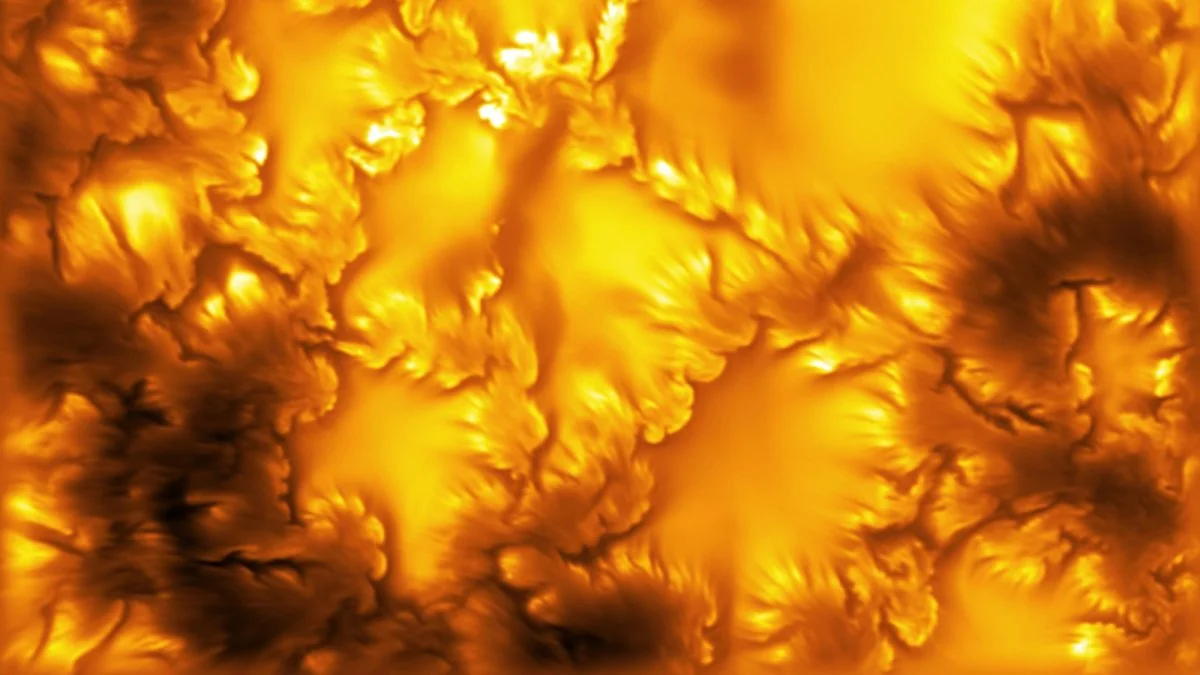
A 74-mile coin read from afar
Observing the surface of the Sun requires peeling back a wall of blinding light and thermal turbulence. To capture features barely 20 kilometers across from Earth, researchers paired the Daniel K. Inouye Solar Telescope in Hawaii with advanced broad-band imaging cameras developed at the Max Planck Institute for Solar System Research. The resolution achieved is equivalent to identifying the portrait of George Washington on a quarter from 74 miles away, exposing cresting plasma swirls dotted along the solar photosphere.
How solar granules generate magnetic turbulence
The visible surface of the Sun, known as the photosphere, acts like a boiling kettle. Rising heat creates giant convection cells called granules that constantly churn across the outer atmosphere. Scientists combined raw telescope data with supercomputer simulations to trace how fluid plasma interacts within these zones:
- Solar granules span between 500 and 2,000 kilometers across, forming the main grid of surface heat exchange.
- Plasma currents move at varying speeds along granule boundaries, generating violent shear forces.
- Shear disturbances trigger Kelvin-Helmholtz instabilities, forming miniature vortex waves along the fringes.
Co-author Sami Solanki noted that «the newly discovered plasma vortices impressively demonstrate how minute processes significantly determine the nature of our star.»
The hidden driver of space weather
For decades, solar physicists struggled to explain why the Sun's upper atmosphere reaches millions of degrees while its surface rests at a comparatively cool 5,500 degrees Celsius. The identification of widespread Kelvin-Helmholtz vortices on 5 August 2026 provides direct evidence for how kinetic energy transforms into magnetic heating. As these 12-mile-wide plasma swirls twist magnetic field lines at microscopic scales, they trigger continuous magnetic reconnection events. This localized turbulence pumps immense energy upward into the solar corona, solving a fundamental energy deficit in solar models and offering precise physical parameters to predict geomagnetic storms that impact Earth's satellite infrastructure.