 EVERYTHING


An Orbital Burst Triggers a Global Telescope Sprint
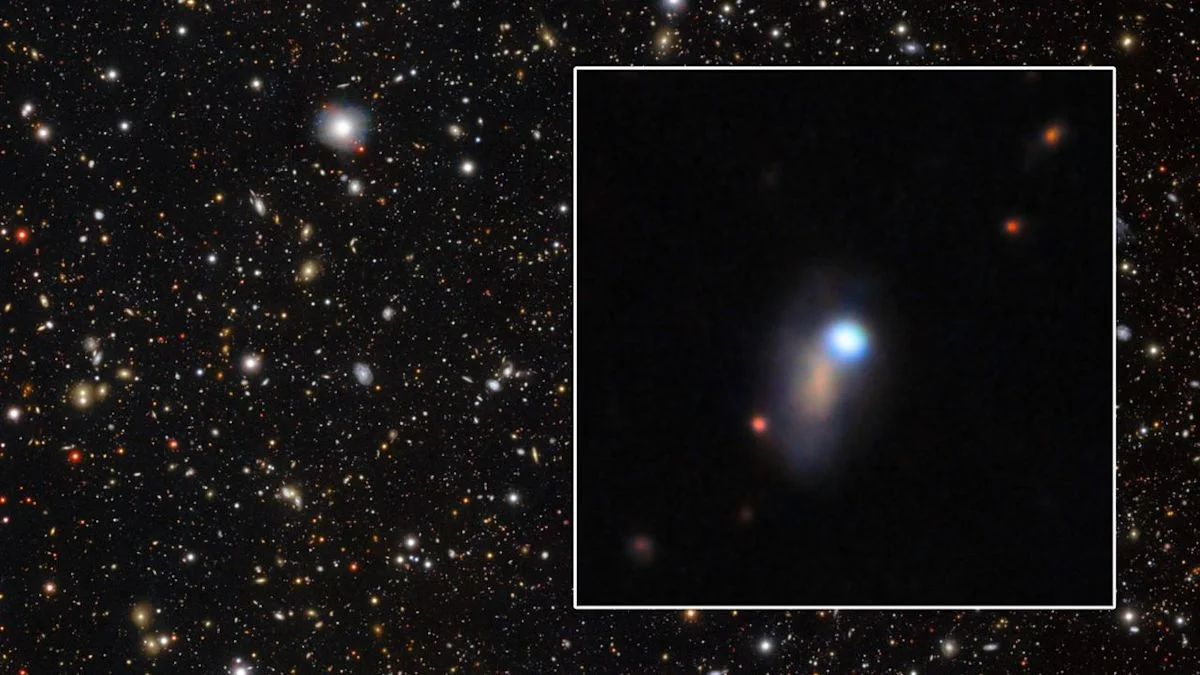
Deep in space, roughly 500 million light-years away, a giant star met its sudden end in a fiery stellar explosion. In March 2026, the Einstein Probe space telescope detected a faint, brief burst of soft X-rays emanating from an unassuming galaxy. The high-energy event was logged under the catalog name EP260321a.
Within less than an hour of the orbital detection, automated network alerts prompted ground observatories across the globe to pivot their massive mirrors toward the target. What they caught in their viewfinders was a rapidly intensifying supernova, designated SN 2026gzf, caught right at the onset of its explosive birth.
Rushing to Capture a Star's Last Blast
For decades, witnessing the exact beginning of a supernova was astronomy's ultimate game of hide-and-seek. When a massive star runs out of fuel, its heavy core collapses under gravity while its outer layers blow outward in a violent shockwave. Think of it like a cosmic pressure cooker bursting its lid—the moment that internal explosion ruptures through the star's gaseous outer skin is known as a shock breakout.
To capture this fleeting shock breakout simultaneously across multiple spectrums, an international network of advanced observatories mobilized within minutes:
- The Einstein Probe wide-field space observatory, which registered the initial soft X-ray flash.
- The Dark Energy Camera mounted on the Víctor M. Blanco 4-meter Telescope in Chile, tracking the sudden optical surge.
- The Vera C. Rubin Observatory, utilizing early test data from its massive camera array to record the explosion's evolution.
Archival Photos Reveal a Pre-Explosion Secret
The real surprise came when researchers dug into historical sky surveys taken years prior to the blast. Archival images recorded by Chilean survey cameras in 2016 and late 2025 revealed a bright blue glow sitting at the exact coordinates of the progenitor star. This unexpected signal meant the star was far from quiet in its final years.
Rather than collapsing peacefully, the supergiant star experienced violent mass eruptions, stripping off its own outer gas layers long before the ultimate explosion occurred. Catching the X-ray shock breakout alongside evidence of these pre-explosion tantrums proves that massive stars undergo chaotic outbursts prior to death, rewriting standard models of how stellar giants meet their end.