Science Read the original on Discover Magazine 1 min read 1

Why an 80-Million-Year-Old Brazilian Skeleton Rewrites Snake History

According to Discover Magazine, paleontologists in Brazil have uncovered an extraordinarily preserved 80-million-year-old fossil that belonged to a primitive snake species known as Tametara mirim. Discovered in the Cretaceous rock layers of São Paulo, this rare articulated skeleton preserves fine skull structures that are almost never seen in ancient reptiles. The specimen is forcing scientists to reconsider how legless creatures adapted to underground environments.

#paleontology #evolution #fossils #Brazil
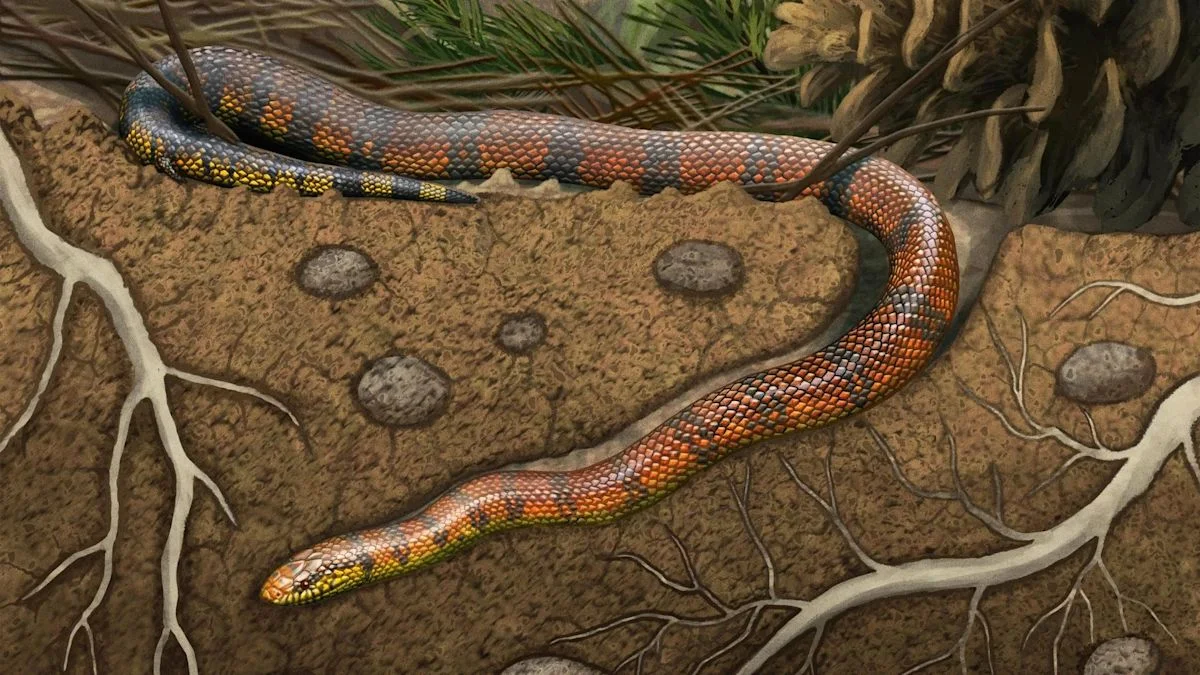
Fossils of an 80-million-year-old snake discovered in Brazil.
Fossils of an 80-million-year-old snake discovered in Brazil. · Image source: Discover Magazine

A Rare Mesozoic Find in São Paulo

In the red sandstone deposits of the Adamantina Formation in São Paulo, Brazil, paleontologists unearthed the remarkably intact skeleton of an ancient serpent dubbed Tametara mirim. Datable to roughly 80 million years ago during the Late Cretaceous epoch, this small reptile belongs to an elite category of paleontology: Mesozoic articulated snake fossils, of which fewer than 10 complete specimens exist worldwide.

Most fossilized snakes consist of fragmented vertebrae scattered by ancient currents. In contrast, this specimen kept its delicate head bones fused to its spine, giving researchers an unfiltered look into early serpent anatomy.

Inside the Subterranean Skull

To examine the internal structures without damaging the fragile stone, researchers utilized high-resolution computed microtomography scans. The digital reconstruction revealed structural traits engineered for a lifestyle below the surface:

  • A reinforced, compact skull capable of withstanding heavy soil pressure during active digging.
  • Modified inner ear canals optimized for low-frequency vibrations rather than airborne acoustic waves.
  • Reduced eye sockets indicating reliance on tactile organs instead of visual acuity.

As one lead investigator noted, «The high-density braincase structure acts like a natural helmet, allowing the animal to wedge through dense earth without fracturing its cranium.»

The Unexpected Pathway of Limbless Evolution

For decades, evolutionary biology debated whether early snakes lost their legs while adapting to marine hunting or terrestrial burrowing. The discovery of Tametara mirim demonstrates that limblessness was not a rigid, single-track evolutionary pipeline. Instead, once primitive reptiles shed their limbs, they rapidly branched into specialized ecological roles.

By conquering the subterranean realm alongside surface-dwelling relatives, early serpents proved that leglessness was a versatile toolkit. The Brazilian fossil reveals that the loss of legs was not merely a physical reduction, but a gateway to colonizing hidden underground worlds during the age of dinosaurs.

Why it matters

Understanding how ancient organisms adapted to ecological niches during mass extinction eras provides critical evolutionary insights into modern biodiversity resilience. The discovery of Tametara mirim in August 2026 adds a key data point to Cretaceous evolutionary modeling, demonstrating how anatomical compaction enabled survival in extreme subterranean habitats. As paleontology increasingly pairs field excavation with non-invasive 3D micro-tomography, researchers globally can reassess archived specimens to trace how limbless vertebrates diversified across prehistoric ecosystems. This breakthrough highlights the growing importance of South American fossil beds in resolving long-standing phylogenetic debates.

FAQ

What makes the Tametara mirim fossil discovery so rare?
Fewer than 10 articulated Mesozoic snake fossils are known worldwide. Most snake fossils consist of scattered vertebrae, but this 80-million-year-old Brazilian specimen preserved an intact skull attached to its spine.
How did scientists determine that Tametara mirim lived underground?
Researchers used high-resolution computed microtomography to scan the fossil. The scans revealed a reinforced, high-density skull and inner ear adaptations specifically suited for burrowing through earth and detecting ground vibrations.
Why is this fossil significant for understanding snake evolution?
The discovery proves that after primitive snakes lost their legs, they quickly diversified into specialized habitats. Tametara mirim shows that underground burrowing was an early evolutionary path alongside surface dwelling.