 EVERYTHING


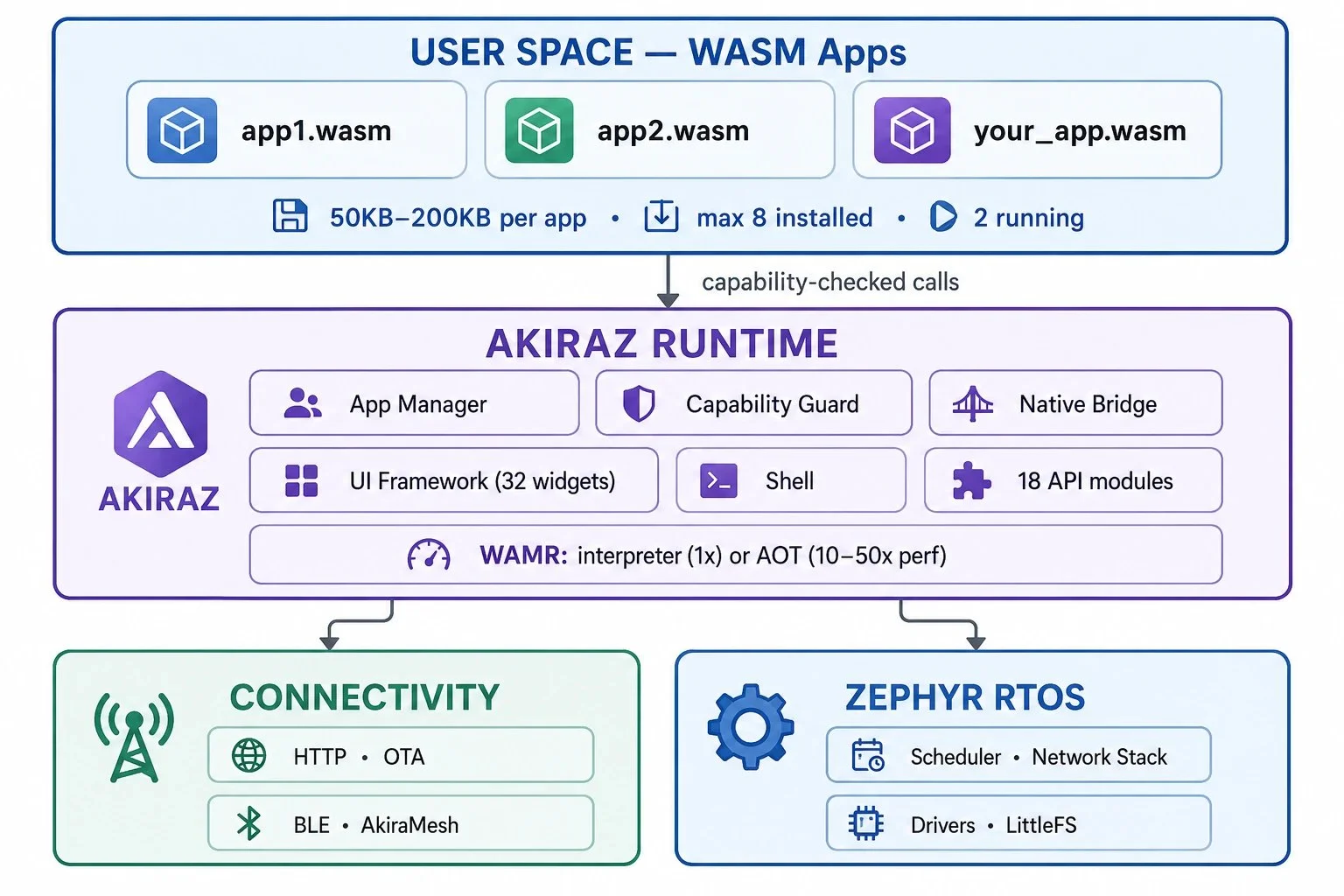
According to Cnx-software, AkiraOS is an embedded OS built on Zephyr that fundamentally changes how applications are managed on microcontrollers. By running sandboxed WASM applications, it effectively decouples the core operating system from the user application layer. This separation ensures that the base firmware remains stable while individual apps operate independently as portable WASM binaries.
The Architecture of Modular Embedded Computing
This modular architecture solves a critical pain point in IoT development: rigidity. Traditional embedded systems often require recompiling and reflashing the entire firmware to update even minor application features. AkiraOS eliminates this dependency, allowing single binaries to run across diverse hardware targets, including ESP32-S3, nRF5x, and STM32 MCU boards.
The platform is built around several key components designed for efficiency and security:
- Akiraz Runtime: A custom WASM runtime offering two deployment options—Interpreter or Ahead-Of-Time (AOT) compilation—which can yield 10 to 50 times higher performance.
- Application Management: Users can install up to 8 WASM apps, with a maximum of 2 running concurrently. Each app footprint is remarkably small, ranging from 50KB to 200KB.
- Security and Isolation: Every application receives only the specific hardware access it explicitly requests, significantly enhancing system security and stability.
Key Features and Operational Benefits
The benefits of adopting AkiraOS extend beyond simple modularity; they address real-world deployment challenges. The ability to update applications in the field without a firmware flash cycle drastically reduces maintenance overhead for deployed devices. Furthermore, if one application crashes due to a bug, the device itself remains operational, thanks to the OS isolation.
The platform includes comprehensive tools necessary for full development and management:
- Connectivity: It features a network stack supporting HTTP for OTA updates and Bluetooth LE for AkiraMesh networking.
- User Interface: A UI Framework provides 32 widgets, complemented by an App Manager and a Shell/console interface.
- Hardware Support: The OS supports Tier 1 targets like the Espressif Systems ESP32 series (including ESP32-S3) and Native_sim for rapid x86-64 iteration. Tier 2 support includes Nordic nRF54L15 and various STM32 Arm Cortex-M microcontrollers.
The project is open source, with documentation and SDKs available on GitHub, indicating a strong commitment to community development in the embedded space. AkiraOS establishes a new standard for dynamic, resilient, and updateable IoT devices.