 EVERYTHING


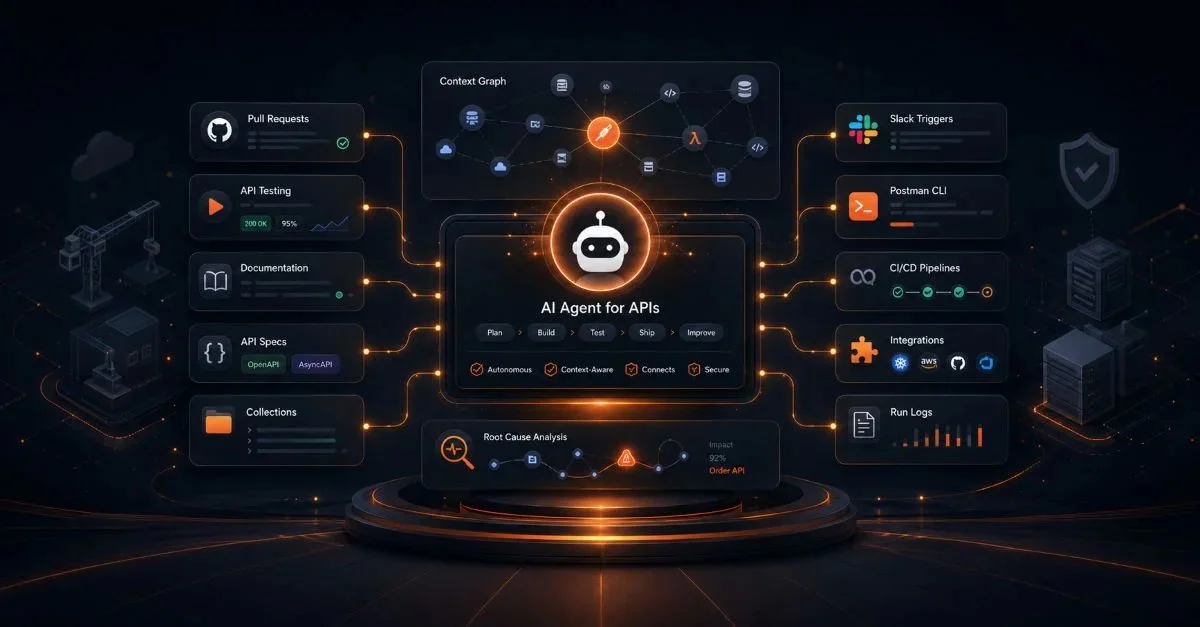
Postman has integrated an artificial intelligence (AI) agent into its suite of tools for building and governing Application Programming Interfaces (APIs). This AI Engineer is designed to autonomously execute tasks that traditionally create bottlenecks in software engineering workflows, covering development, documentation, exploration, and integration with Continuous Integration/Continuous Deployment (CI/CD) environments. According to Devops, the new agent aims to make API development and testing significantly simpler within existing developer pipelines.
Automating the Development Lifecycle
The AI Engineer is highly versatile in its deployment, capable of being triggered from various points in a team's workflow, including a pull request, Slack, the Postman command line interface (CLI), or directly through the Postman application. When activated, the agent establishes a secure, sandboxed environment to execute tasks and return verified artifacts. These outputs include:
- Collections and test results
- API specifications and run logs
- Pull requests and temporary cloud workspaces for team review
This capability allows teams to streamline their processes by having the AI Engineer automatically run API and Quality Assurance (QA) tests on every pull request, posting the results directly back into established developer workflows.
Advanced Analysis and Contextual Intelligence
Beyond routine testing, the AI Agent is equipped to investigate complex API issues and accelerate root cause analysis. It can trace dependencies across multiple services, actively test APIs, and return actionable hypotheses complete with reproduction steps. A key differentiator of this tool is its reliance on a Postman Context Graph database. This graph captures detailed information about how an API was built, changed, and governed over time.
Abhinav Asthana noted that leveraging this existing context allows the AI Engineer to generate more reliable output compared to general-purpose AI agents. The integration of such contextual data is crucial for efficiency; without access to a method providing this context, an AI agent risks needlessly burning tokens investigating information readily available in a graph.
The Future of DevOps Orchestration
While the degree of API management integration into DevOps workflows remains evolving, Asthana suggests that AI will simplify bridging the boundaries between various tools and platforms. He further pointed out that Postman’s AI agent may communicate directly with agents created by providers of other DevOps platforms to complete a single task. This signals a shift toward highly coordinated, multi-agent systems within enterprise environments.
However, Asthana cautioned that teams must determine which tasks are best assigned to one AI agent versus another and will require an orchestration framework to manage the growing number of autonomous agents. As organizations increasingly focus on controlling AI costs, graph databases like Postman's Context Graph prove essential for maintaining efficiency. The current challenge is not whether to incorporate AI into DevOps workflows, but rather how effectively those agents are constructed and managed.
Ultimately, this development positions API governance as a highly automated function, requiring sophisticated orchestration to manage the growing army of specialized AI workers.