 EVERYTHING


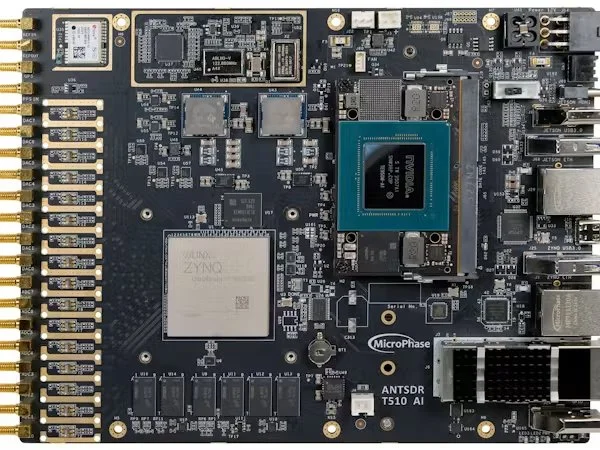
According to Hackster, MicroPhase Technology has introduced the AntSDR T510 AI to streamline the development of next-generation wireless technologies. The platform is specifically engineered to address the challenges of modern wireless research, where moving massive amounts of data between separate hardware components often creates significant bottlenecks and synchronization issues.
Integrated Hardware Architecture
The AntSDR T510 AI solves these problems by housing two distinct processing powerhouses on one board. At its core is the AMD Zynq UltraScale+ RFSoC ZU47DR, which provides programmable logic and high-speed RF data converters for deterministic tasks like digital upconversion and multi-channel synchronization. Complementing this is an NVIDIA Jetson module, which serves as the primary engine for computationally heavy workloads such as AI inference, signal classification, and spectrum analysis.
By keeping both subsystems on a single platform, developers can move from raw RF capture to intelligent analysis without streaming data to a separate workstation. Key technical specifications of the hardware include:
Scalability and Software Support
The platform is designed for both standalone use and large-scale deployments. Multiple boards can be synchronized to expand the system beyond eight channels, potentially supporting 16, 32, or more RF paths. The hardware offers various timing options, including external clock references, onboard OCXO/TCXO sources, GPS timing, and PPS trigger support.
To lower the barrier for entry, MicroPhase has preconfigured the Jetson module with Ubuntu 22.04 and CUDA. The system supports popular frameworks like GNU Radio and SoapySDR, while an open driver framework called IQTAXI allows developers to use high-level APIs in Python or C++. This approach reduces the specialized FPGA knowledge typically required for such complex hardware. MicroPhase plans to release firmware sources and AI workflow examples through a public GitHub repository to support the developer community.
The AntSDR T510 AI represents a significant shift toward consolidated edge computing for wireless sensing, radar, and massive MIMO applications. By merging high-speed signal acquisition with immediate AI processing, it provides a streamlined path for creating responsive, intelligent wireless environments.