 EVERYTHING


A Rare Alignment in Deep Space
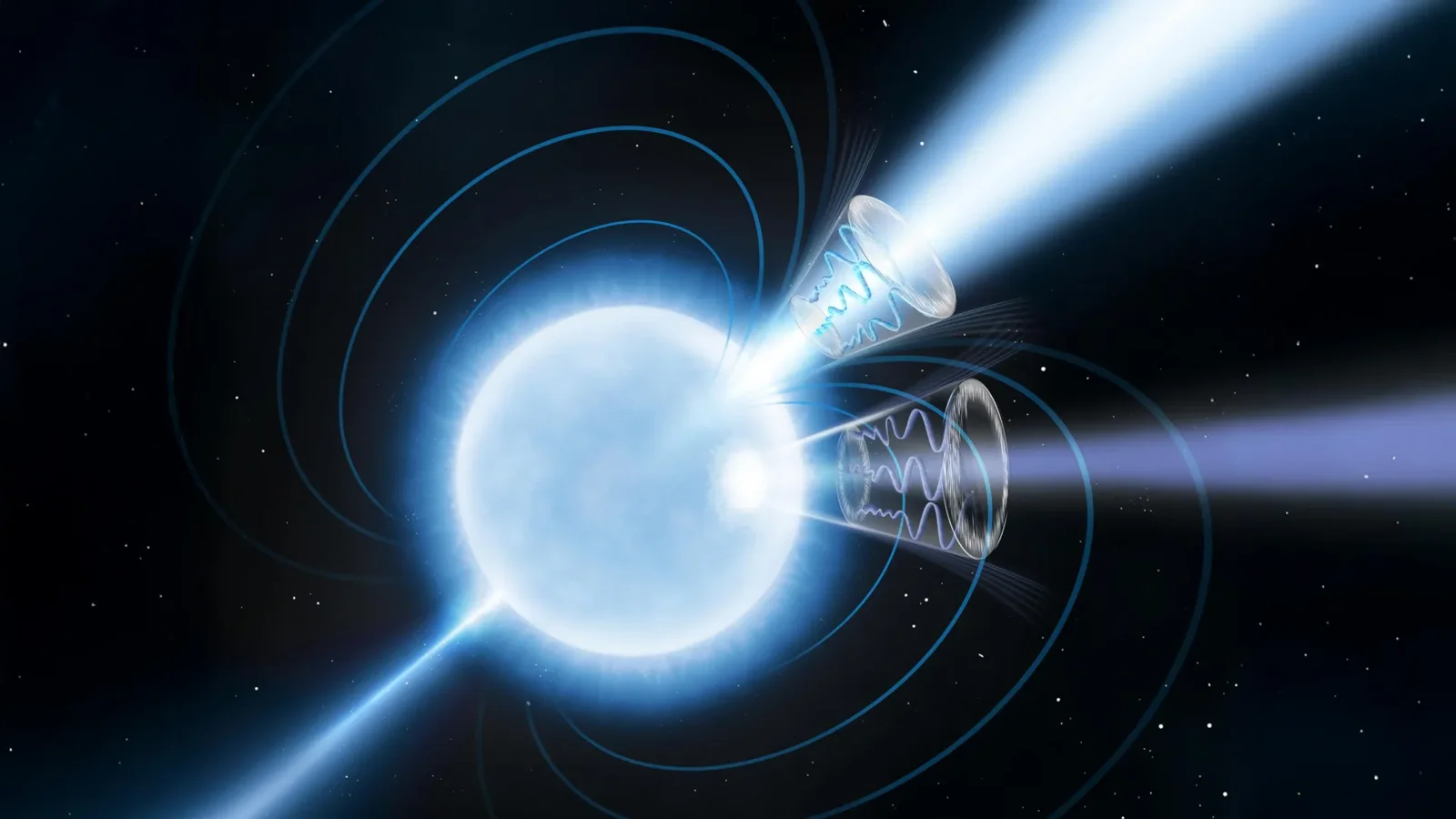
Researchers led by Dr. Marcus Lower of the Swinburne University of Technology targeted magnetar 1E 1547.0-5408, a superdense dead star spinning in deep space with a magnetic field over a trillion times stronger than Earth’s. Magnetars represent the most intense magnetic environments in the known universe, creating conditions impossible to replicate in terrestrial laboratories.
Using NASA’s Imaging X-ray Polarimetry Explorer alongside ground-based radio observatories, the team analyzed how electromagnetic waves twist as they escape the star. The unique geometry of 1E 1547.0-5408, viewed almost directly from its magnetic pole, offered a clean line of sight into quantum interactions taking place just above its crust.
Virtual Particles and Cosmic Polarimetry
To understand why empty space behaves like an optical prism, think of the quantum vacuum not as a sterile void, but as a restless sea where pairs of matter and antimatter particles pop into existence and annihilate in fractions of a second. Under ordinary conditions, this subatomic froth remains invisible. However, when an overwhelming magnetic field sweeps through, it polarizes these virtual particles, aligning them like iron filings along magnetic field lines.
As light passes through this magnetized vacuum, different polarization states travel at slightly different speeds — an effect known as vacuum birefringence. The multi-observatory campaign gathered data across several key platforms:
- NASA IXPE measured X-ray polarization levels reaching between 40% and 80% near the star’s magnetic hotspots.
- The Murriyang radio telescope captured pulse timing using CSIRO’s 64-meter dish in Australia to map the star’s rotation axis.
- The Ngarrgu Tindebeek supercomputer processed high-resolution simulations to isolate quantum signals from stellar noise.
Dr. Lower explained that verifying this interaction required cosmic extremes. «Detecting vacuum birefringence requires a magnetic field that is over 100 million times stronger than any we’ve ever made on Earth,» Lower noted, emphasizing that magnetars serve as nature’s ultimate particle physics laboratories.
Confirming Heisenberg's 1936 Prediction
The smooth, highly coherent shift in polarization observed as 1E 1547.0-5408 rotates matches theoretical predictions of Quantum Electrodynamics almost perfectly. Instead of light scattering randomly off high-energy plasma, the polarization direction strictly followed the magnetar’s magnetic field lines, providing the clearest empirical signal yet that empty space actively modifies radiation.
Beyond validating a 90-year-old calculation by Werner Heisenberg, the discovery establishes polarimetry as a powerful tool for probing fundamental physics. If further observations confirm the signature, astrophysicists will gain a new method to test the limits of quantum theory in extreme gravity and electromagnetic regimes where standard laboratory physics breaks down.