 EVERYTHING


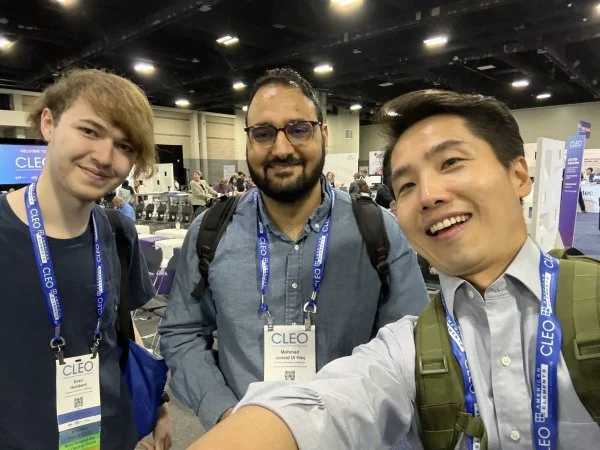
According to the UTC Quantum Center blog, Dr. Mohmad Junaid Ul Haq earned second place at the Conference on Lasers and Electro-Optics (CLEO) in Charlotte, North Carolina. The CLEO Science Slam requires participants to distill highly technical work into an engaging 10-minute presentation for a diverse audience. Dr. Ul Haq’s research focused on solving fundamental challenges related to quantum networking using EPB's fiber infrastructure, miniature atomic clocks, and White Rabbit timing technology.
The Challenge of Quantum Entanglement
At the core of Dr. Ul Haq’s talk was quantum entanglement—a concept that describes a connection between particles regardless of distance. To make this complex idea accessible, he used an analogy: two magic dice rolled in different cities (Charlotte and Tokyo). He explained that these dice match because they were never truly separate to begin with, demonstrating the non-local connection between photons.
However, proving that entanglement exists across a network demands extraordinary timing precision. When sending entangled photons to detectors at separated locations, such as Broad Street and 10th Street, researchers must ensure synchronization down to sub-nanosecond levels—one-billionth of a second. This precise alignment is a major hurdle for the UTC Quantum Center team.
Synchronizing the Quantum Network
The research involves combining high-precision timing systems with specialized hardware to maintain system alignment over long distances. The team initially utilized White Rabbit, a sophisticated timing protocol, to synchronize their experimental setup. They then explored whether miniature atomic clocks could serve as an alternative when dedicated timing links were impractical.
Dr. Ul Haq noted the successful outcome of this comparative study:
- The research combined White Rabbit with time taggers and atomic clocks.
- The goal was to support quantum networking experiments across separate locations.
- The atomic clock approach produced comparable results over eight continuous hours of measurement, validating its potential use in field applications.
Dr. Ul Haq emphasized that the ability to communicate scientific findings is as crucial as the research itself. He stated, “It’s really important for me to stand up there and explain the problem, because we had solved a very fundamental problem.” This work not only advances quantum technology but also reinforces the belief that complex science should be accessible to help people understand it.
The successful presentation earned Dr. Ul Haq a $500 cash award, marking a significant recognition of his efforts in bridging advanced physics with public communication.