 EVERYTHING


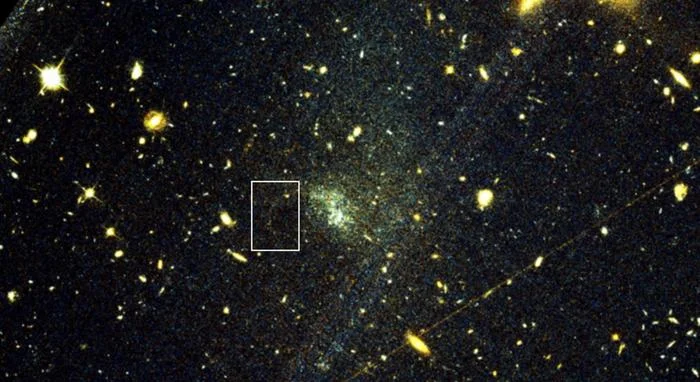
First extra-galactic star stream discovered in a ghostly cosmic neighbor
Imagine a tightly wound ball of yarn dropped into a moving river. As the water pulls at the threads, the yarn unravels into a long, thin stream trailing downstream. In space, gravity acts like that river. When a dense cluster of stars passes through a galaxy, gravitational tides pull stars away one by one, stretching the cluster into a long, faint ribbon known as a globular cluster stellar stream.
Lead researcher Julie Kiel Holm from the Niels Bohr Institute and associate professor Sarah Pearson from DTU Space identified the first such stream ever observed beyond our Milky Way. The stellar trail stretches across UGC9050-Dw1, a faint ultra-diffuse galaxy that emits remarkably little visible light. Until now, astronomers believed these delicate structures were too dim to detect across intergalactic distances.
How gravitational tides turn stellar clusters into cosmic scales
Because stars in a stream follow the shape of the invisible gravitational field around them, they act like natural cosmic sensors. As dark matter makes up roughly 85 percent of all matter in the universe without emitting any light, mapping its distribution requires measuring how its gravity pulls on visible objects.
The research team published their findings in Nature after analyzing deep astronomical imaging data. The discovery provides several critical scientific advances:
- Confirmation that tidal stripping operates in distant ultra-diffuse galaxies just as it does inside the Milky Way.
- Direct structural evidence allowing scientists to estimate the total mass of dark matter halos surrounding external galaxies.
- Validation of automated detection algorithms designed to pinpoint extremely faint stellar structures in large sky surveys.
Pearson noted that finding this stream in a dwarf galaxy confirms that dark matter dominates the structure of ultra-diffuse stellar systems, matching theoretical predictions with empirical proof.
A universal yardstick for mapping invisible cosmic architecture
Before this discovery, every measurement of dark matter derived from stellar streams was restricted to a sample size of one: the Milky Way. Astrophysicists could never be entirely sure whether local stream dynamics reflected universal laws or unique features of our cosmic home environment.
Demonstrating that globular cluster stellar streams can be detected and measured in foreign galaxies transforms a local observational trick into a universal diagnostic tool. Upcoming space observatories, including the Euclid Space Telescope and the Nancy Grace Roman Space Telescope, are built to survey millions of distant stellar systems. Astronomers will soon deploy this method across diverse galaxy types, turning faint ribbons of stars into a comprehensive map of the dark universe.