 EVERYTHING


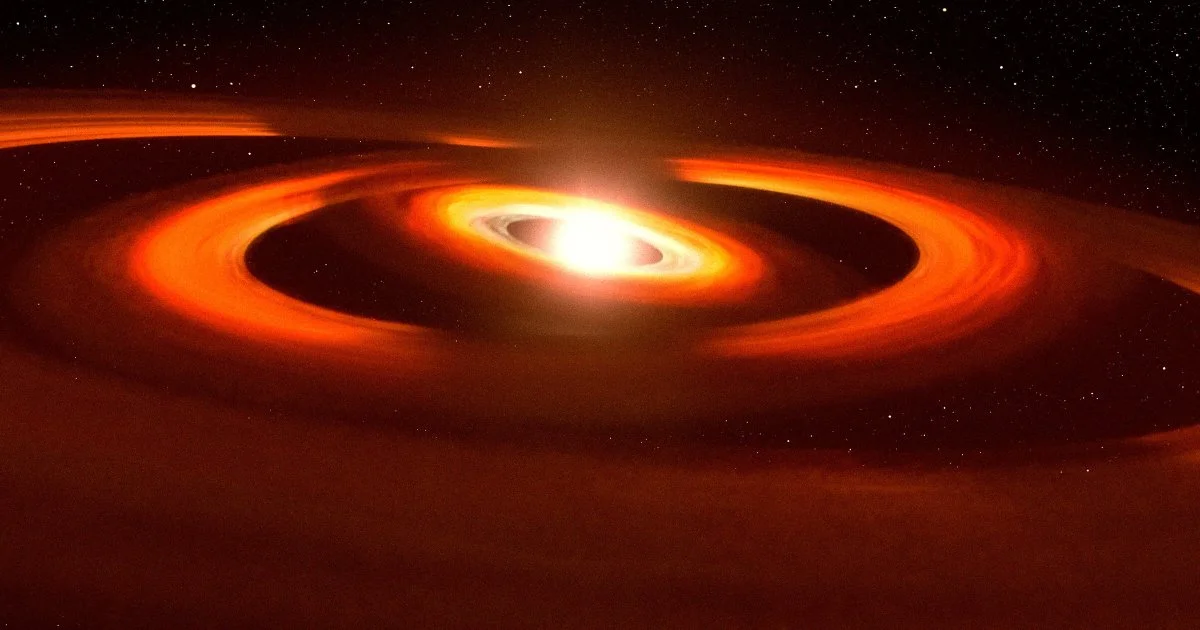
An Ancient Red Giant That Is Not a Star
Astronomers examining deep-field infrared imagery captured by the James Webb Space Telescope spotted a brilliant crimson object dating back to less than 700 million years after the Big Bang. Dubbed MoM-BH*-1, the cosmic structure packs roughly 100,000 times the mass of our Sun inside a colossal envelope of hydrogen gas that stretches across the width of a full planetary system.
Imagine wrapping a cosmic engine inside an extraordinarily thick stellar blanket. To conventional telescopes, the object mimics a hyper-luminous red star, but its core operates under entirely different laws than the thermonuclear fires that power standard suns.
Unmasking the Secret Engine of Little Red Dots
For years, astrophysicists were baffled by hundreds of dense, crimson spots scattered across early cosmic history known to researchers as Little Red Dots. These mysterious formations seemed far too small to be full galaxies, yet entirely too bright and massive to be ordinary stars.
By analyzing light spectra filtered through hydrogen, the research team decoded how MoM-BH*-1 manages to outshine its surroundings:
- A supermassive gravitational anchor at the center continually consumes surrounding matter, releasing 100 billion times more radiant energy than our Sun.
- An impenetrable outer layer of dense gas traps extreme X-ray radiation, preventing high-energy photons from escaping into space.
- A severe drop in specific light wavelengths reveals pristine hydrogen gas acting as a natural optical filter around the central object.
A Cosmic Prototype That Rewrites Early Universe History
The identification of MoM-BH*-1 provides the first direct evidence for quasi-stars—hypothetical celestial hybrids proposed nearly two decades ago. Rather than forming after stars die, these behemoths allowed supermassive black holes to grow inside colossal gas cocoons during the dawn of time.
This discovery explains how supermassive black holes achieved millions of solar masses so quickly after the Big Bang without violating cosmic growth limits. By feeding uninterrupted inside their own stellar gas cloaks, these ancient black hole stars seeded the giant gravitational engines that now anchor modern galaxies across the universe.