 EVERYTHING


A Glass Cone That Turns Solar Chaos into Quantum Order
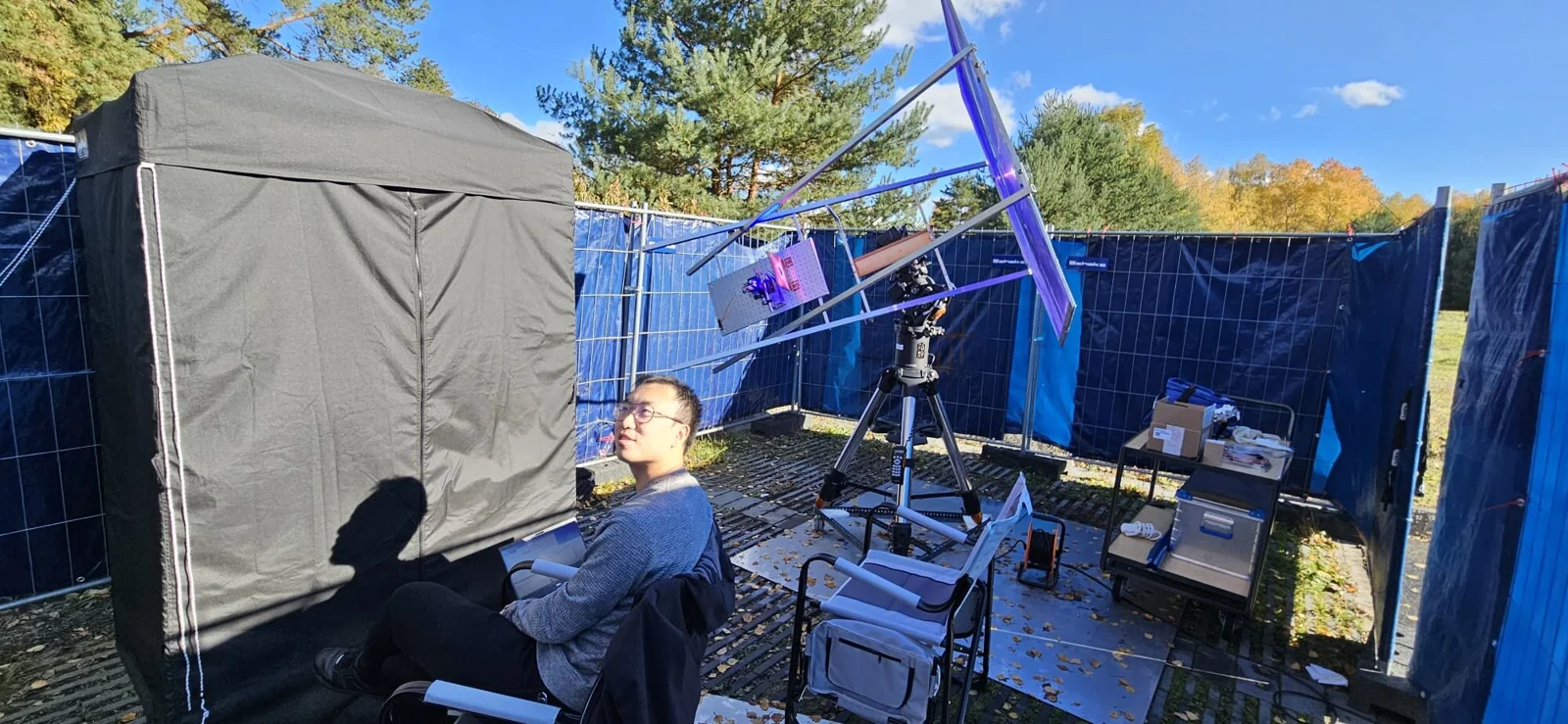
Researchers led by Cheng Li and Robert Boyd at the University of Ottawa focused raw sunlight through a custom optical assembly to split individual solar photons into entangled pairs. The team placed a window-sized Fresnel lens outdoors to gather sunlight, concentrating the beam into a cone-shaped glass device designed by Hanieh Fattahi's group at the Max Planck Institute for the Science of Light. That glass cone funneled light into an optical fiber narrower than a human hair, striking a tiny nonlinear crystal inside a lightproof tent.
Traditional quantum experiments rely on precise, single-wavelength lasers because their light waves march in perfect lockstep. Sunlight behaves like a chaotic crowd shouting in thousands of different pitches and directions at once. To overcome this noise, the experimental setup isolated a single characteristic of the solar photons while leaving their color and direction uncontrolled.
Filtering Polarization Without Sacrificing Light Fidelity
The physical process relies on spontaneous parametric down-conversion, a quantum phenomenon where a higher-energy photon passing through a nonlinear crystal splits into two lower-energy daughter photons. By carefully engineering the optical path, the physicists ensured that temporal and spatial disorder did not disrupt the polarization alignment of the emerging photon pairs.
Outdoor optical measurements published in Optica revealed several critical performance metrics for the sunlight-driven system:
- Entangled state fidelity reached 94% relative to an ideal laser-generated quantum state.
- Photon correlations violated Bell's inequality, confirming genuine quantum mechanics rather than classical optical effects.
- Optical throughput matched theoretical predictions across broad sunlight spectra without requiring active laser cooling.
As first author Cheng Li noted during testing: «Sunlight-driven entanglement generation could also provide the crucial ingredient needed to scale up quantum computing without adding to the energy burden.»
Space Satellites Could Ditch Lasers for Ambient Sunlight
The primary impact of this discovery centers on orbital infrastructure and large-scale quantum networks. Quantum key distribution satellites currently depend on power-intensive onboard lasers to beam unhackable encryption keys down to Earth stations. In orbit, solar radiation is naturally intense and uninterrupted by weather or atmosphere. Equipping satellite nodes with lightweight solar concentrators rather than heavy laser systems drastically reduces payload weight, launch costs, and electrical power demands.
Beyond orbital security, replacing power-hungry lasers with solar collection modules removes a major thermodynamic bottleneck in ground-based quantum data centers. By proving that disordered natural light can generate quantum links, our editors note that photonics engineers can now design hybrid quantum architectures that tap ambient light, fundamentally shifting how future quantum infrastructure interacts with energy grids.