 EVERYTHING


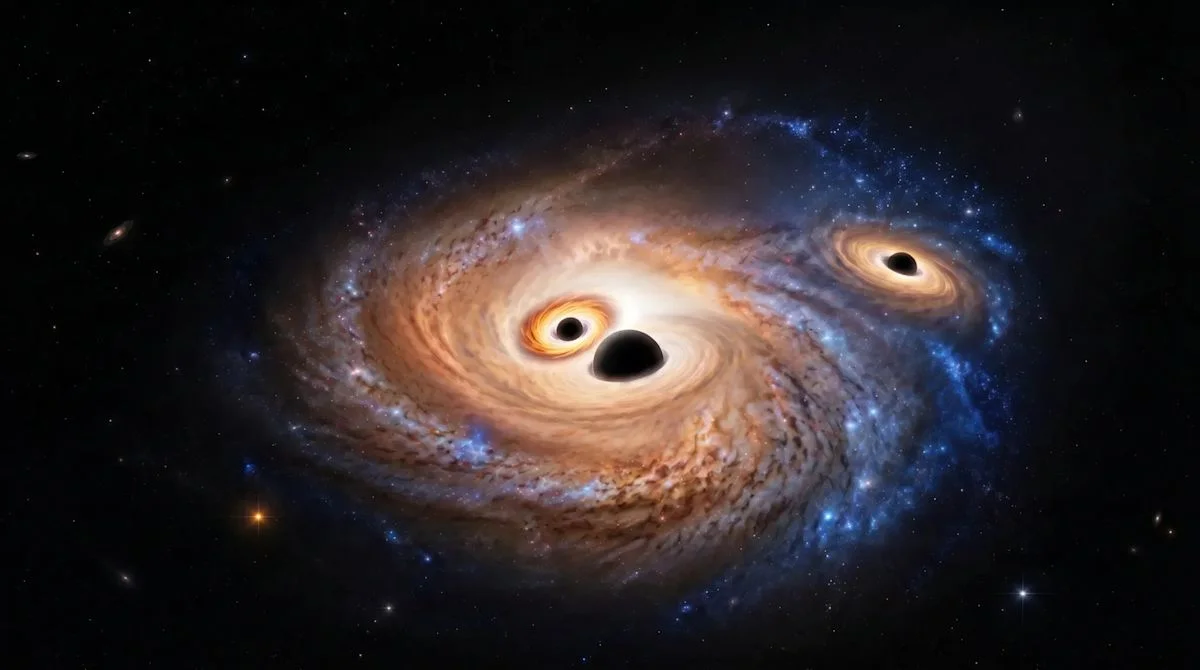
A Triple Cosmic Engine 12.5 Billion Light-Years Away
Observing galaxy J0148-4214 is like looking through a temporal telescope back to the universe’s childhood. Light from this distant realm has traveled for more than 12.5 billion light-years to reach Earth, offering astronomers a view of the galaxy at redshift z=5.02, just 1.2 billion years after the Big Bang. Instead of finding a single calm galactic core, instruments on the James Webb Space Telescope detected something far more chaotic.
Spectroscopic data from Webb’s NIRSpec instrument revealed three distinct active galactic nuclei—supermassive black holes actively pulling in surrounding gas—all crammed within the same galaxy. Think of it as discovering three massive engines mounted inside a single compact sports car, all revving at top speed simultaneously.
How Three Supermassive Monsters Share One Galaxy
In the modern universe, big galaxies typically host only one supermassive black hole at their center. Finding two during a galaxy merger is rare, but finding three actively feeding giants packed together is an extraordinary anomaly. Astronomers traced the fast-moving hydrogen gas surrounding each black hole to map their precise positions within galaxy J0148-4214:
- The Central Pair: Two supermassive black holes sit near the core, separated by a projection distance of only 190 light-years—an extraordinarily tight orbital distance on a galactic scale.
- The Outer Companion: A third active black hole orbits further out in the galactic structure, marking the remnant core of another galaxy caught in the gravitational collision.
- Simultaneous Feeding: All three black holes are actively accreting gas at the same time, turning the galactic interior into an intensely luminous cosmic construction zone.
The Ancient Pipeline Solves a Cosmic Growth Mystery
For years, astrophysicists faced a frustrating puzzle: how did supermassive black holes in the early universe grow to millions or billions of times the mass of our Sun so quickly? Standard growth models suggested that steady feeding on interstellar gas simply took too long. The discovery of J0148-4214 provides the missing empirical evidence.
Rather than growing slowly in isolation, early black holes experienced rapid bulk growth through chaotic, multi-galaxy pileups. As two or three galaxies smashed together, enormous amounts of gas were funnelled directly into the central regions, creating a massive feeding trough for all black holes involved. Furthermore, the two central black holes separated by just 190 light-years are destined to lock into a gravitational dance and eventually merge. This process will radiate powerful gravitational waves, offering a preview of the massive orbital collisions that future observatories like LISA are designed to detect.