 EVERYTHING


The concept of insight—the sudden understanding of cause and effect without relying on previous knowledge or copying others—has long been central to animal cognition research. Historically, German psychologist Wolfgang Köhler established this idea over 100 years ago through his famous chimpanzee experiments. In those trials, chimps were presented with a banana out of reach and various items like boxes and poles; they eventually demonstrated insight by stacking the objects to access the reward.
While most animals can perform basic problem-solving, Köhler's work highlighted that true insight is a higher cognitive function observed in only a handful of species, including great apes and elephants. However, an ongoing scientific debate questions whether invertebrates like octopuses or certain spiders should also be included among spontaneous solvers.
Testing the Limits of Insect Cognition
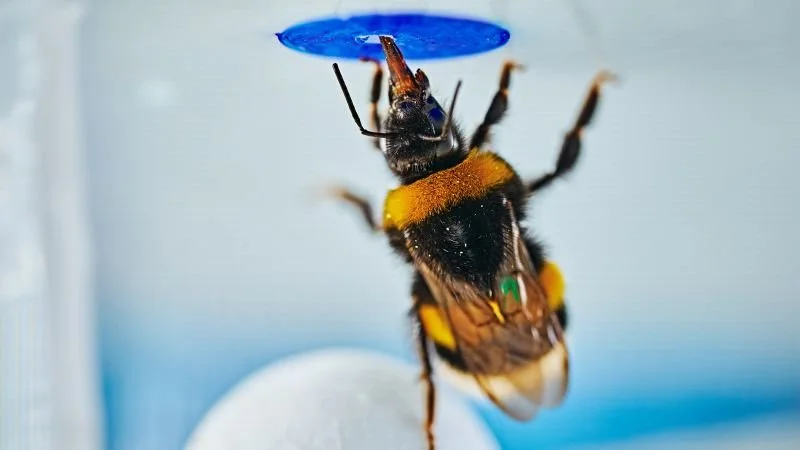
According to CNN, a recent study published in the journal Science provides compelling evidence that bumblebees possess this same capacity for insight. In a controlled laboratory setting, researchers presented the insects with a complex challenge: they needed to roll a plastic foam ball underneath an artificial blue flower, climb over the ball, and use it as a platform to reach a sugary reward.
Lead author Akshaye Bhambore, a doctoral researcher at the University of Oulu in Finland, stated that the findings demonstrated for the first time that bumblebees could solve a completely novel object-manipulation task spontaneously. Crucially, the researchers exposed the insects to the separate elements of the task but never trained them on the solution itself.
The Mechanics of Spontaneous Problem Solving
The experiment utilized a circular arena measuring about 10 centimeters in diameter and 3.2 centimeters tall. The setup involved three scenarios designed to test different levels of understanding:
- Scenario 1: Familiarization. Bees explored the artificial blue flower containing the sugary solution, while a small foam ball was placed nearby to ensure it was not perceived as a threat.
- Scenario 2: Basic Manipulation. The ball covered the flower, and insects successfully pushed it away to gain access to the reward.
- Scenario 3: Insight Test. In this final scenario, the researchers moved the flower from the floor to the ceiling, placing it just above one of four pits designed to accommodate the foam ball.
The results were significant; a majority of the bees exposed to the initial scenarios—75% of them—managed to roll the ball into the correct pit and climb onto it to reach the elevated flower.
Implications for Pollinator Behavior
This discovery suggests that even a tiny insect brain can support surprisingly flexible behavior. James Nieh, a professor at the University of California San Diego who was not involved in the study, noted that while bees do not typically move objects around to create platforms naturally, the experiment proves they can remember a hidden goal location and manipulate an object relative to that objective.
Natalie Hempel de Ibarra, an associate professor of neuroethology at the University of Exeter in England, added that this flexibility could profoundly shape how bees and other pollinators interact with flowers. She suggested that such cognitive adaptability would help them cope with challenges as environments and landscapes undergo change. The study opens a new avenue for understanding complex learning mechanisms across diverse species.