 EVERYTHING


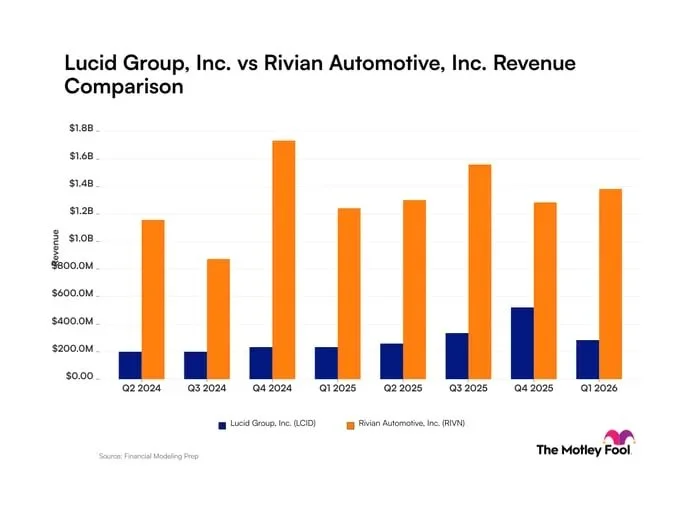
According to Aol, the battle between Lucid (NASDAQ:LCID) and Rivian Automotive (NASDAQ:RIVN) highlights two distinct strategies in the high-stakes EV industry. While Lucid focuses on engineering luxury electric vehicles and powertrains, Rivian centers its business on manufacturing and selling electric pickup trucks, SUVs, and commercial delivery vans directly to consumers.
Financial Performance and Revenue Trends
The financial data reveals a clear disparity in current revenue streams. In the first quarter of 2026, for instance, Lucid reported $282.5 million in revenue, whereas Rivian generated $1.4 billion. This trend shows that Rivian has maintained a significantly higher and more consistent revenue base across recent quarters.
The companies' financial health is complex; both have reported negative net income margins. Lucid reported approximately -364% net income margin for the quarter ended March 31, 2026, while Rivian reported around 30%. Despite these losses, Rivian achieved a major milestone by reaching its first full year of gross profit in 2025.
Rivian's Strategic Growth and Partnerships
Rivian’s financial strength is heavily fortified by strategic alliances. The company recently unlocked $1 billion in funding from the Volkswagen Group (OTC:VWAGY), a long-standing partner, which provides substantial capital for growth. Furthermore, Rivian has secured significant commercial agreements:
- A robotaxi agreement with Uber for 50,000 vehicles.
- Uber’s investment of over $1 billion to fund the development of these electric vehicles.
Rivian anticipates delivering between 62,000 and 67,000 EVs in 2026, reflecting nearly 50% growth compared to the previous year. This robust revenue base is supported not only by vehicle sales but also by commercial partnerships and software licensing.
Lucid's Scaling Challenges and Leadership Shift
Lucid has historically struggled with scaling production and deliveries as anticipated, leading to choppy revenues despite securing substantial backing. The company is heavily backed by Saudi Arabia's Public Investment Fund (PIF) and holds an agreement with Uber to sell at least 35,000 robotaxis built on the Lucid Gravity SUV platform.
In response to operational challenges, Lucid announced a leadership transition, with Silvio Napoli taking over as CEO starting June 1. This change comes alongside securing approximately $1.05 billion through public offerings and private investments. Investors are watching closely to see if this new management can translate backing into consistent production and revenue growth.
Conclusion
While Lucid continues its pursuit of high-end luxury EV market share, Rivian’s current financial standing—characterized by higher quarterly revenues, major corporate partnerships, and a clear path toward profit milestones—positions it as the stronger contender in the immediate top-line race within the electric vehicle sector.