 EVERYTHING


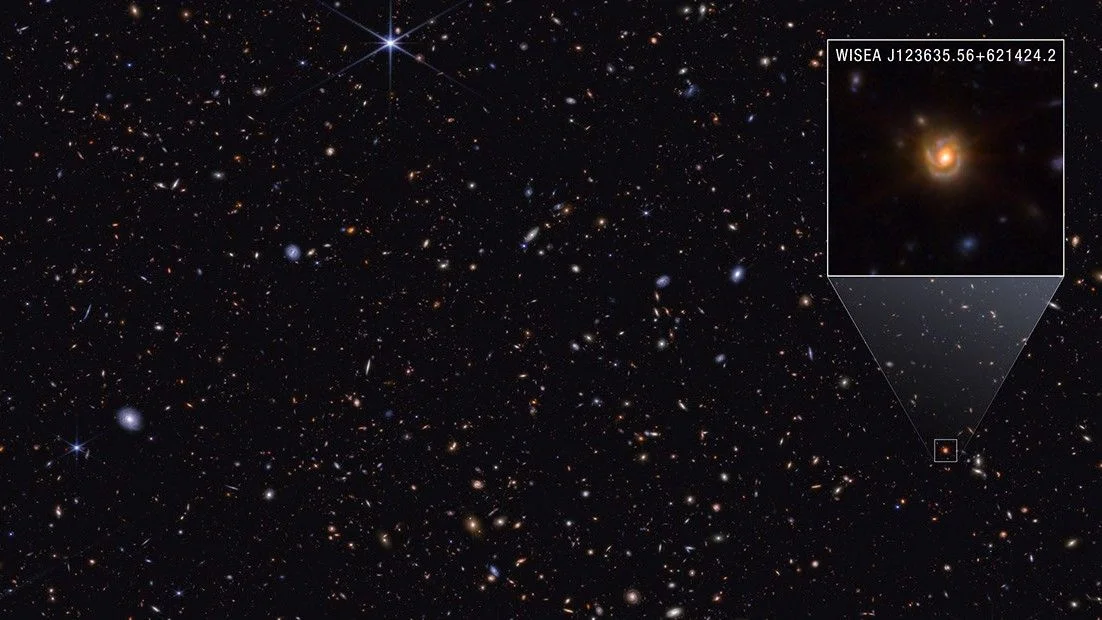
A Cactus-Shaped Galaxy Under the Webb Lens
Ever since NASA's James Webb Space Telescope began science operations, astronomers have been puzzled by tiny crimson spots lurking in deep-field images of the early universe. These mysterious objects appeared in vast numbers around 600 million years after the Big Bang, only to seemingly evaporate from cosmic surveys less than a billion years later. To investigate whether these objects were a short-lived exotic phenomenon or something far more familiar, a research team led by astronomer Pierluigi Rinaldi from Steward Observatory at the University of Arizona turned Webb toward a closer target.
Scientists selected galaxy WISEA J123635.56+621424.2, affectionately nicknamed Saguaro because its sweeping spiral arms resemble the iconic Sonoran Desert cactus. Located approximately 10 billion light-years away in the constellation Ursa Major, Saguaro represents a universe existing roughly 3.3 billion years after the Big Bang. Crucially, Saguaro features a compact, brilliant red central core that matches nearly every spectral signature of the early crimson spots, but sits close enough for high-resolution cameras to resolve its surrounding structure.
Fading Arms and a Crimson Core
Think of looking at a distant city skyline on a foggy night: from fifty miles away, the glowing radio beacon atop a skyscraper remains visible while the entire building around it fades into the dark. To test if a similar optical trick was fooling space telescopes, researchers combined Webb's infrared data with observations from the Hubble Space Telescope and NASA's Chandra X-ray Observatory to build high-fidelity digital models of Saguaro.
Using computational physics, the team artificially pushed Saguaro deeper into space to match the extreme distances of the early cosmos. As the galaxy receded in the simulation, a striking transformation occurred:
- The faint stellar disk and sweeping spiral arms gradually dissolved into cosmic background noise.
- The galaxy's overall light emission dropped until outer star-forming regions became completely invisible to infrared detectors.
- The dense, dust-enshrouded central core remained stubbornly bright, appearing as an isolated red point of light.
The Cosmic Disappearing Act Solved
The simulation revealed that the early universe's mysterious red dots never actually vanished from existence. Instead, they were the hyper-dense, dust-choked central cores of infant spiral galaxies harboring actively growing supermassive black holes. During the cosmic dawn, the surrounding star-forming disks of these young galaxies were simply too faint and spread out for even Webb's powerful mirror to pick up across 13 billion light-years.
As cosmic time marched forward and galaxies matured, their surrounding stellar disks accumulated enough mass and starlight to break through observational thresholds. What appeared to be the sudden extinction of a mysterious cosmic species was actually an illusion of observational resolution. This resolution confirms that supermassive black holes and spiral galaxies grew hand-in-hand much earlier in cosmic history than previously thought, solving one of Webb's most intriguing observational puzzles.