 EVERYTHING


A 400-Billion-Sun Cosmic Detonation in Deep Space
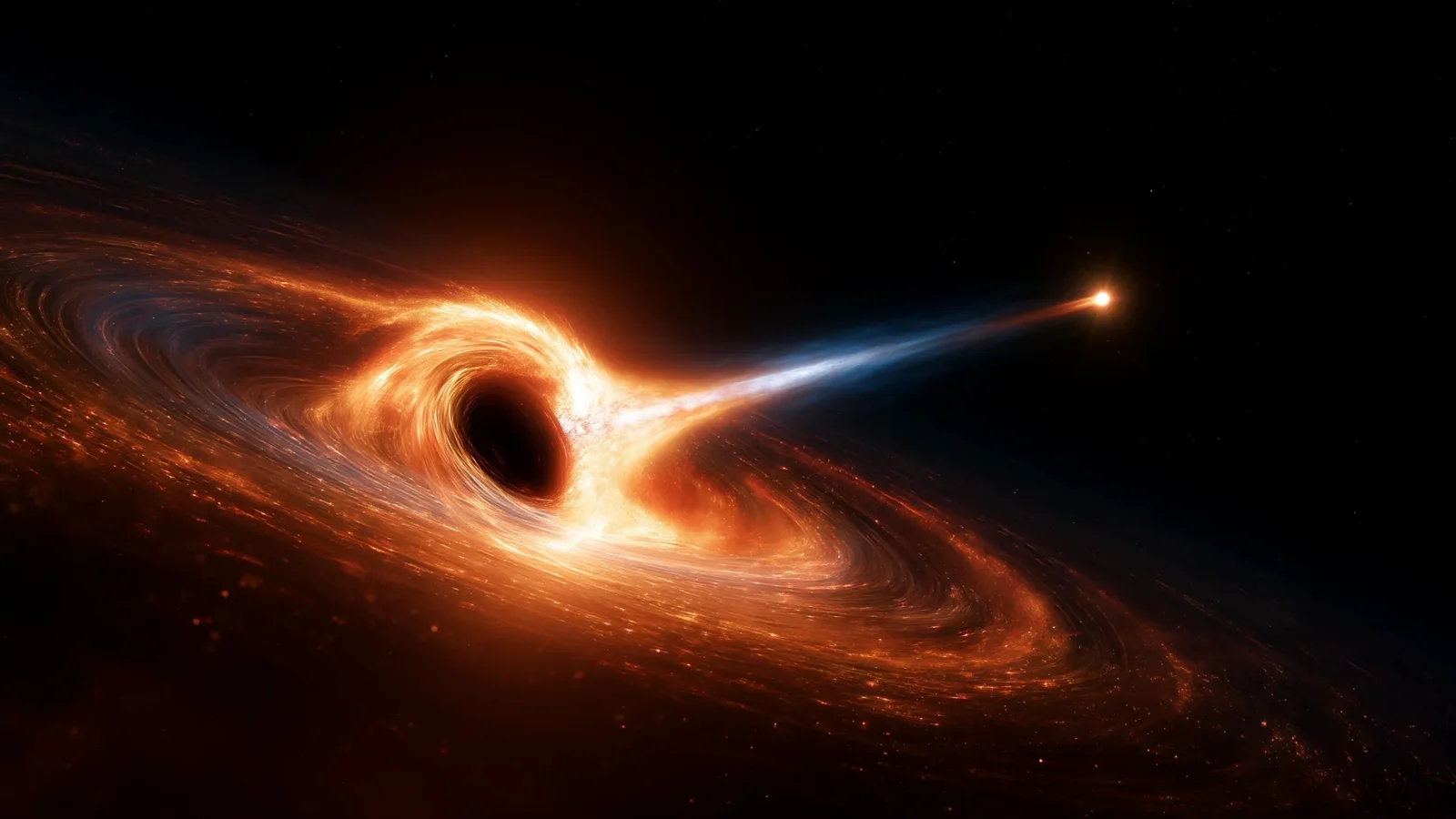
When a star wanders too close to a black hole, extreme gravity acts like a celestial blender, stretching the star into a long ribbon before devouring it. Astronomers call this a tidal disruption event, but the newly observed transient AT2024wpp shattered standard cosmic scales. Discovered using the Zwicky Transient Facility in California, the event briefly unleashed energy equivalent to 400 billion times the brightness of our Sun, outshining typical stellar collapses and supernovae.
Rapid follow-up observations by the Liverpool Telescope in the Canary Islands and NASA's Swift satellite confirmed that the light displayed unusual characteristics. The blast glowed an intense blue and produced powerful X-ray bursts, classifying it as a rare Luminous Fast Blue Optical Transient (LFBOT). Distances measured by teams at Caltech and UCLA showed the monster explosion resulted from a massive star being torn apart and converted into a superheated disk feeding the black hole.
Tracking the Whippet Across the Electromagnetic Spectrum
As gas from the shredded star spiraled into the event horizon, it reached extreme temperatures and generated powerful outward winds. These superheated outflows slammed into gas that the doomed star had shed earlier in its life, driving a shock wave outward at roughly one-fifth the speed of light. Multiple observatories tracked the evolving physics across different wavelengths:
- The Liverpool Telescope and NASA's Swift recorded the initial ultraviolet and blue light emissions during the first few days.
- The Very Large Telescope and Keck Observatory analyzed the expanding debris cloud over subsequent months.
- Radio and millimeter arrays detected radiation generated as the blast wave collided with surrounding gas shells.
After nearly six months of intense expansion, the shock wave appeared to fizzle out. Astrophysicists infer that the blast reached the outer edge of a massive gas bubble created long before the star met its fate.
A Fast-Moving Helium Signal Hints at a Surviving Stellar Core
The true surprise emerged when astronomers examined spectral lines from the fading aftermath. Observations from the Keck and Magellan observatories revealed weak signals of helium gas racing along our direct line of sight at 6,000 kilometers per second. Finding fast-moving, intact helium months after such a violent explosion presents an intriguing puzzle.
Researchers suggest two primary explanations for this lingering structure. The helium could represent a dense stream peeled from the star's inner core that managed to resist complete destruction during the initial plunge. Alternatively, the signal might originate from a hidden third star in the system that survived the initial gravitational shredding but is currently being blasted by intense particle winds from the central engine.