 EVERYTHING


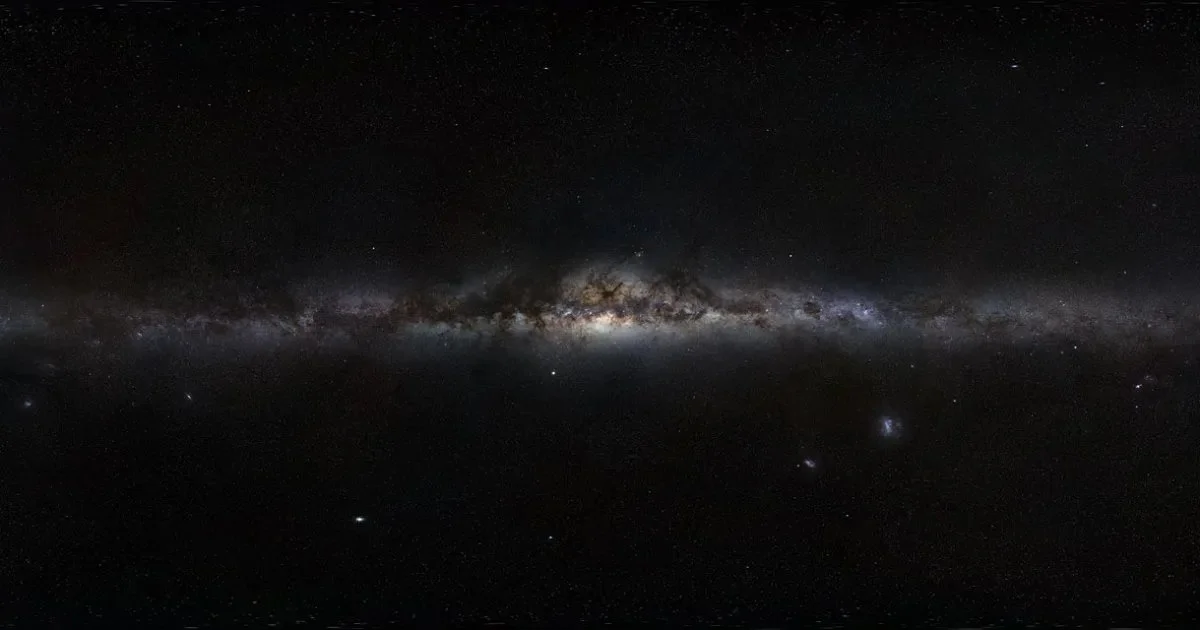
Understanding the distribution of galaxies across the cosmos requires accurate mapping, but our own galaxy presents a major obstacle. For decades, scientists suspected that vast structures lurked behind the Milky Way’s dense disk—a region known as the Zone of Avoidance. This area blocks visible light and obscures nearly one-fifth of the sky, making optical observation impossible.
Seeing Through Cosmic Dust with MeerKAT
According to Astronomy, researchers leveraged South Africa's powerful MeerKAT radio telescope to overcome this limitation. Instead of relying on starlight, which is scattered by dust, MeerKAT detects the 21-centimeter emission line from neutral hydrogen gas. This specific radio signal passes through cosmic dust largely unimpeded.
The technique involves measuring the redshift—the frequency shift of the hydrogen line based on a galaxy's speed away from Earth due to the universe’s expansion. By tracking this shift across thousands of galaxies, scientists can effectively reconstruct the structure in three dimensions. Renée Kraan-Korteweg, an astronomy professor at the University of Cape Town and co-author on the study, noted that while its presence could be inferred previously, tracing its full extent was impossible.
- The Vela supercluster is estimated to stretch about 300 million light-years across.
- The survey revealed more than 2,000 galaxies that had not been seen before.
- The structure contains an immense amount of material, estimated at 3 x 10¹⁶ solar masses.
Mapping the Raw Material for Future Stars
This new mapping effort has resolved what was previously only a faint overdensity into a massive structure featuring two dense cores that appear to be moving toward each other within a larger gravitational system. Crucially, the hydrogen signal provides more than just location data; it highlights cold, denser gas reservoirs throughout the galaxy population.
This colder gas is considered the raw material from which new stars form. Therefore, the map not only indicates where matter resides but also pinpoints areas primed for future stellar creation. The ability to see through the Milky Way’s veil using radio astronomy fundamentally changes how cosmologists view large-scale structure in our local universe.
The detailed mapping of Vela confirms that even seemingly impenetrable regions of space hold some of the most massive and complex features in the nearby cosmos, offering critical insights into galactic evolution.