 EVERYTHING


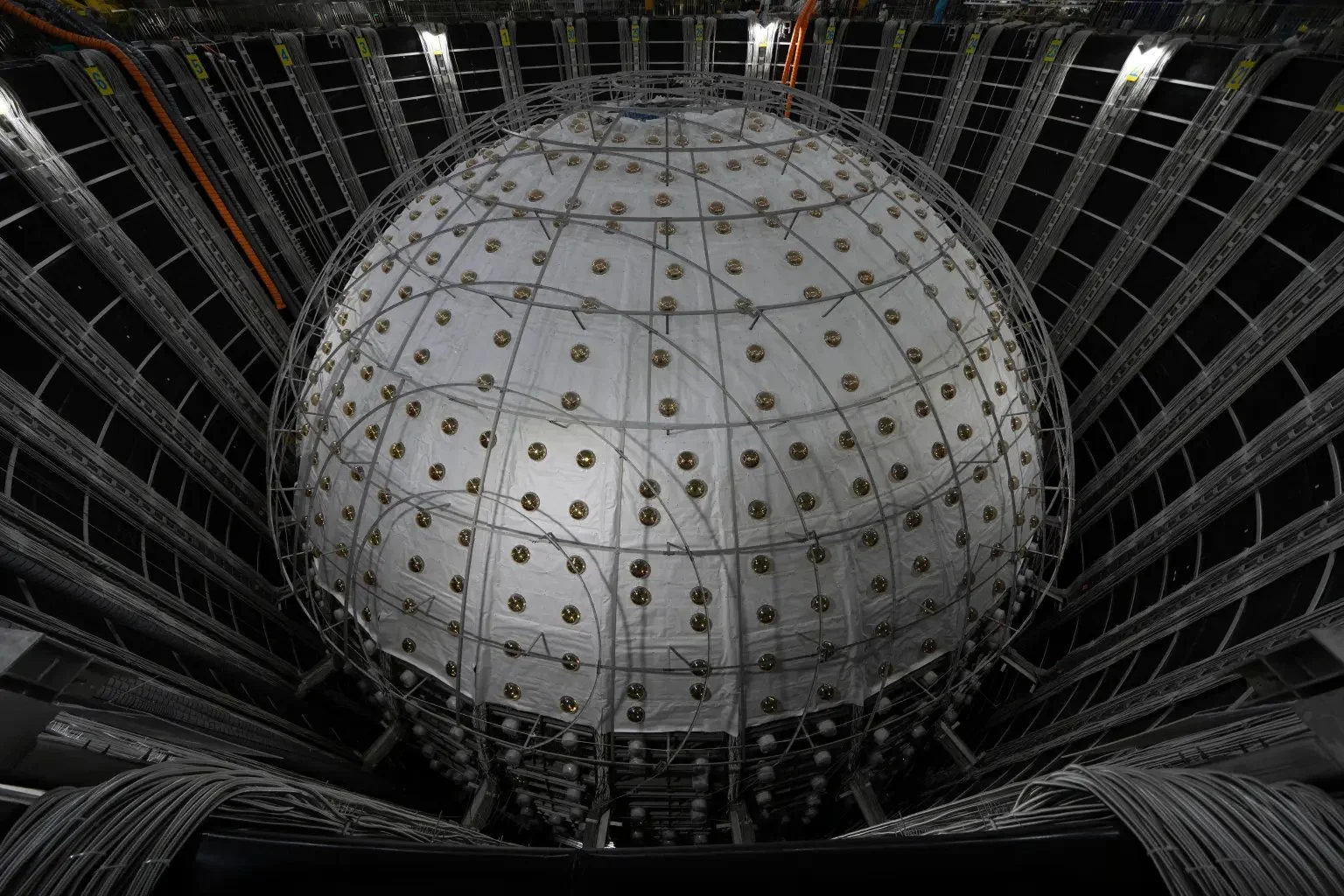
According to Universemagazine, the initial scientific results from the JUNO facility have been published in the journal Nature. The observatory is located roughly 650 meters beneath a rock massif near Kaiping in China's Guangdong province. This massive detector was designed specifically to capture and study neutrinos, which are fundamental particles that travel through stars, planets, and human bodies with almost no interaction due to their lack of electric charge.
Advancing the understanding of neutrino oscillations
Neutrinos are produced in extreme environments, such as the cores of stars like our Sun or during supernova explosions. Scientists recognize three distinct types, often referred to as "flavors," which can transform into one another as they move through space—a process known as oscillation. While it is established that neutrinos possess mass, a primary mystery remains: determining the specific mass order of these particles.
The JUNO detector has already begun providing clarity on these complexities. The initial 59 days of data allowed researchers to measure two out of six fundamental oscillation parameters with unprecedented accuracy. While the results do not yet provide a definitive answer regarding mass ordering, they represent a significant leap forward in precision.
- The detector is located 650 meters underground to shield it from cosmic noise.
- It utilizes a spherical reservoir filled with 20,000 tons of organic liquid.
- The facility monitors antineutrinos originating from the Yangjiang and Taishan nuclear power plants.
- Data collection helps address why matter dominates over antimatter in the universe.
Technological scale and cosmic implications
To capture these "ghost particles," researchers required a massive infrastructure costing approximately $300 million. The detector works by monitoring the organic liquid, which flashes with light when struck by an antineutrino. This setup allows scientists to observe processes that are otherwise invisible to conventional telescopes.
Looking ahead, JUNO is expected to capture particles from solar flares and supernovae. These observations may eventually provide keys to understanding dark matter, dark energy, and the fundamental evolution of the universe. "The figures not only have huge value for neutrino physics but also prove the extraordinary efficiency of the new large-scale detector," — Ivan Wang, a scientist at the Institute of High Energy Physics of the Chinese Academy of Sciences and spokesperson for the JUNO collaboration.
By refining our measurements of subatomic behavior, the JUNO project brings humanity one step closer to understanding the underlying architecture of reality. The success of this first phase confirms that the facility is capable of meeting its ambitious scientific goals over the coming years.